
 E-submission
 KOTA
 TOTA
 TOTS

Search
- Page Path
- HOME > Search
Systematic Reviews
- Definitions and assessment of residual distal radioulnar joint instability after operative fixation of distal radius fractures: a methodological systematic review
- Jae Ho Cho, Seungyeob Sakong, Sumin Lim
- J Musculoskelet Trauma 2026;39(4):323-340. Published online October 19, 2026
- DOI: https://doi.org/10.12671/jmt.2026.00290
-
 Abstract
 PDF
 Supplementary Material
- Background
Residual distal radioulnar joint (DRUJ) instability after operative fixation of distal radius fractures serves as an eligibility criterion, treatment indication, and outcome, but previous syntheses report inconsistent definitions. This methodological systematic review examined how clinical reports define, assess, and report it, and whether they distinguish it from structural triangular fibrocartilage complex (TFCC) lesions.
Methods
MEDLINE (PubMed) and Embase were searched from 2015 to 3 August 2026 for adult clinical reports in which residual DRUJ instability was assessed after fixation, or inferred from TFCC lesion characteristics, and used for a treatment decision or as an outcome. Every report entering full-text eligibility was assessed independently in duplicate; data were locked before agreement was calculated and disagreements disclosed. No riskof- bias tool was applied: neither treatment effects nor diagnostic accuracy were estimated. Findings are counts and proportions; no meta-analysis was performed.
Results
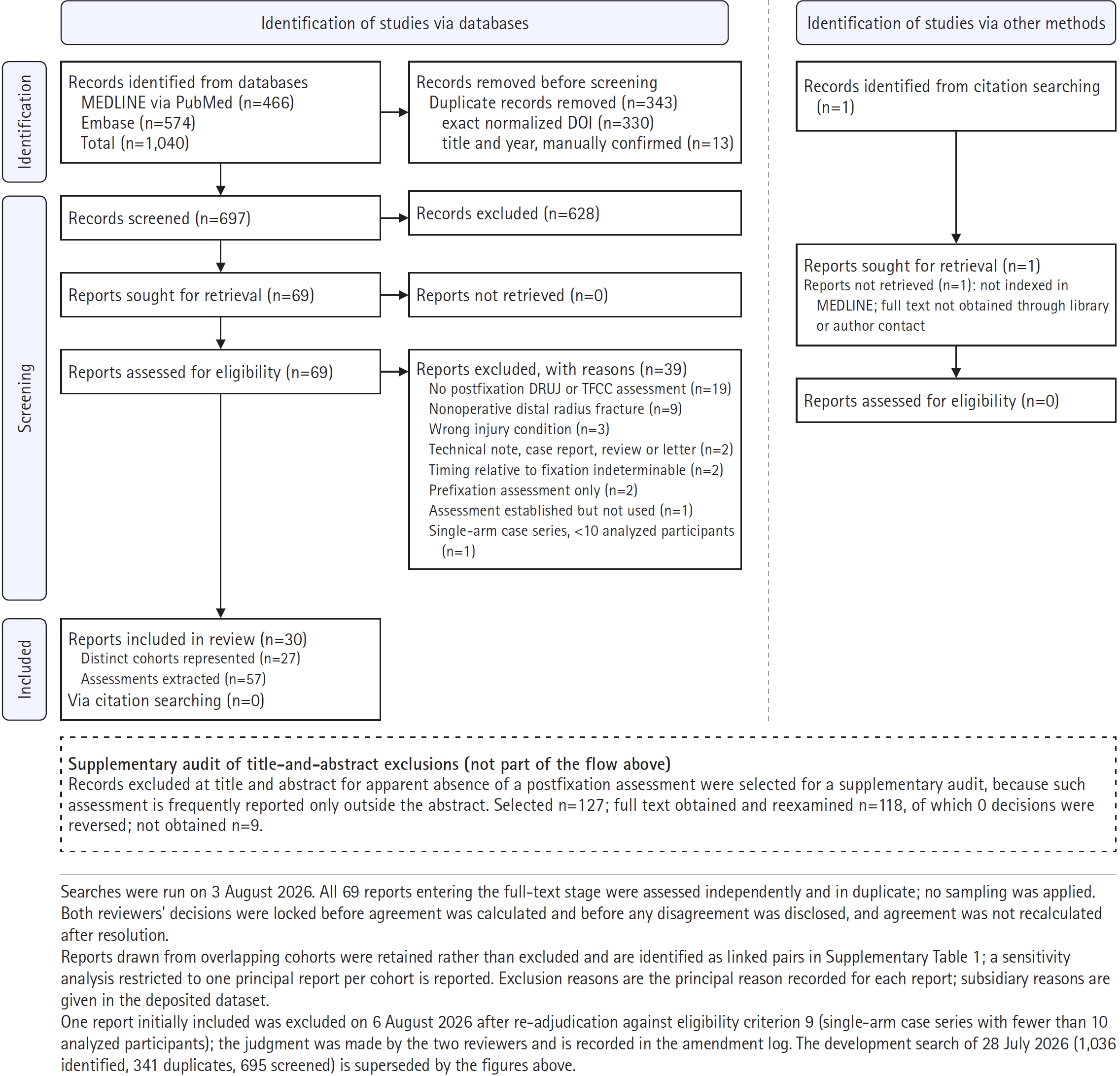
Of 1,040 records, 697 were screened and 69 assessed as full texts; 30 reports of 27 cohorts were included, contributing 57 assessments. In the treatment-decision context, 12 reports stated an operational definition (40.0% of all 30; 50.0% of the 24 containing such an assessment), four stated neither required element (16.7% of 24), and six contained no such assessment and were classified as not applicable. At the assessment level, the positive criterion was vague in 43.9% and absent in 17.5%, and explicit for 48.0% of intraoperative but 25.9% of final follow-up assessments. No report inferred instability from a TFCC lesion instead of testing the joint; one used the two constructs interchangeably, 14 (46.7%) distinguished them, and 15 (50.0%) addressed instability without structural verification. A comparable prevalence estimate was extractable from only 9 of 57 assessments (15.8%).
Conclusions
Residual DRUJ instability is therefore assessed frequently but is often incompletely defined, and until these elements are stated consistently, frequency estimates cannot be compared across studies. Level of evidence: Not applicable.
- 97 View
- 5 Download

- Impact of posterior wall involvement and fixation on clinical and radiographic outcomes of associated both-column acetabular fractures: a systematic review and meta-analysis
- Chul-Ho Kim, Eic Ju Lim
- J Musculoskelet Trauma 2026;39(4):310-322. Published online October 19, 2026
- DOI: https://doi.org/10.12671/jmt.2026.00248
-
Abstract
PDFSupplementary Material
- Background
Posterior wall (PW) fractures are frequently associated with both-column (ABC) acetabular fractures. However, whether the presence of a PW fragment or the need for internal fixation affects prognosis remains a topic of debate. This study compared postoperative outcomes, including reduction quality and clinical results, according to the presence of an associated PW fracture and whether PW fixation was performed.
Methods
This systematic review and meta-analysis followed the Preferred Reporting Items for Systematic Reviews and Meta-Analyses (PRISMA) 2020 guidelines. MEDLINE, Embase, and the Cochrane Library were searched for articles published up to December 10, 2025. Comparative studies of ABC fractures were included if they evaluated the presence or absence of PW involvement or compared internal fixation with nonfixation of the PW component. Clinical and radiographic outcome data were extracted.
Results
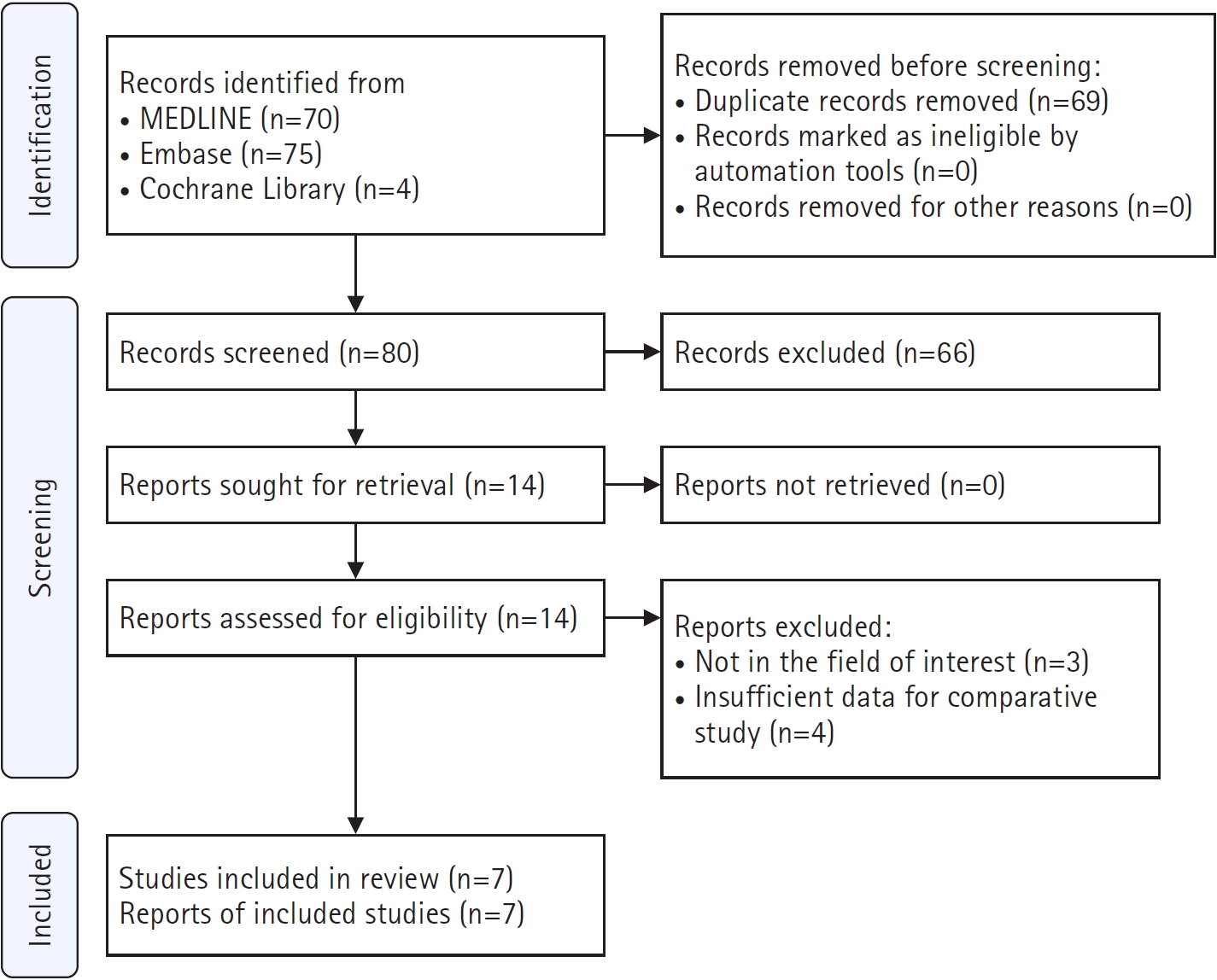
Seven retrospective studies including 434 analyzable patients were included. No clear differences were found in the odds of poor reduction (odds ratio [OR], 0.91; 95% confidence interval [CI], 0.43–1.94; P=0.80), osteoarthritis (OR, 1.04; 95% CI, 0.37–2.92; P=0.94), or conversion to total hip arthroplasty (OR, 0.63; 95% CI, 0.23–1.71; P=0.36) according to the presence of a PW fragment in ABC fractures. Among ABC fractures with PW involvement, nonfixation was associated with numerically higher odds of poor reduction than fixation, although the difference was not statistically significant (OR, 1.47; 95% CI, 0.46–4.76; P=0.52). In unadjusted comparisons of non-randomized cohorts, PW fixation was associated with significantly longer operative time (mean difference [MD], 70.38 min; 95% CI, 24.46–116.29; P=0.003) and greater intraoperative blood loss (MD, 351.36 mL; 95% CI, 244.97–457.74; P<0.00001). The final modified Merle d'Aubigné-Postel score did not differ significantly between the fixation and nonfixation groups (MD, 0.58 points; 95% CI, −0.57 to 1.74; P=0.32).
Conclusions
Current evidence does not clearly support routine fixation of all PW fragments. In unadjusted comparisons of non-randomized cohorts, patients who underwent PW fixation had longer operative time and greater blood loss. These differences cannot be attributed to fixation itself because of confounding by indication and the frequent use of an additional posterior approach. Selective fixation based on residual displacement, joint congruency, and hip stability appears reasonable, although the certainty of evidence remains limited. Level of evidence: Not applicable.
- 83 View
- 2 Download
Original Article
- Safety and Effectiveness of the Anchor Augmentation with Bone Cement on Osteoporotic Femoral Fracture: A Systematic Reviews
- So Young Kim
- J Korean Fract Soc 2019;32(2):89-96. Published online April 30, 2019
- DOI: https://doi.org/10.12671/jkfs.2019.32.2.89
-
Abstract
PDF
- PURPOSE
This paper reviewed the safety and effectiveness of anchor augmentation with bone cement in osteoporotic femoral fractures.
MATERIALS AND METHODS
A systematic review was conducted by searching multiple databases including five Korean databases, Ovid-MEDLINE, Ovid-EMBASE, and Cochrane Library. Safety was assessed through the incidence of complication. The effectiveness was assessed through the failure rate of anchor fixation, improvement of function and radiological assessment (sliding distance of lag screw and cutout). The safety and effectiveness of anchor augmentation with bone cement were assessed by reviewing all articles reporting on the treatment. Two researchers carried out independently each stage from the literature search to data extraction. The tools of Scottish Intercollegiate Guidelines Networks were used to assess the quality of studies.
RESULTS
Six studies were considered eligible. The safety results revealed a small amount of cement leakage (1 case), but no other severe complications were encountered. Regarding the effectiveness, the failure rate of anchor fixation was 16.7% and the Harris's hip score showed no significant improvement. The sliding distance of the anchor was similar in the cement augmentation group and non-cement group but there was no cutout.
CONCLUSION
The results of the assessment suggest that the safety is acceptable, but further research will be needed to verify the effectiveness of the treatment.
- 1,500 View
- 5 Download
 First
 Prev



