
 E-submission
 KOTA
 TOTA
 TOTS

Articles
- Page Path
- HOME > > Ahead-of print articles > Article
-
Systematic Review
- Definitions and assessment of residual distal radioulnar joint instability after operative fixation of distal radius fractures: a methodological systematic review
-
Jae Ho Cho
 , Seungyeob Sakong, Sumin Lim
-
DOI: https://doi.org/10.12671/jmt.2026.00290
Published online: October 19, 2026
Department of Orthopedic Surgery, Ajou University School of Medicine, Suwon, Korea
- Correspondence to: Seungyeob Sakong Department of Orthopedic Surgery, Ajou University School of Medicine, 164 Worldcup-ro, Yeongtong-gu, Suwon 16499, Korea Tel: +82-31-219-5220 Email: sgsy4040@gmail.com
• Received: August 11, 2026 • Revised: August 30, 2026 • Accepted: September 10, 2026
© 2026 The Korean Orthopaedic Trauma Association
This is an Open Access article distributed under the terms of the Creative Commons Attribution Non-Commercial License (http://creativecommons.org/licenses/by-nc/4.0/) which permits unrestricted noncommercial use, distribution, and reproduction in any medium, provided the original work is properly cited.
- 92 Views
- 3 Download


Abstract
-
Background Residual distal radioulnar joint (DRUJ) instability after operative fixation of distal radius fractures serves as an eligibility criterion, treatment indication, and outcome, but previous syntheses report inconsistent definitions. This methodological systematic review examined how clinical reports define, assess, and report it, and whether they distinguish it from structural triangular fibrocartilage complex (TFCC) lesions.
-
Methods MEDLINE (PubMed) and Embase were searched from 2015 to 3 August 2026 for adult clinical reports in which residual DRUJ instability was assessed after fixation, or inferred from TFCC lesion characteristics, and used for a treatment decision or as an outcome. Every report entering full-text eligibility was assessed independently in duplicate; data were locked before agreement was calculated and disagreements disclosed. No risk-of-bias tool was applied: neither treatment effects nor diagnostic accuracy were estimated. Findings are counts and proportions; no meta-analysis was performed.
-
Results Of 1,040 records, 697 were screened and 69 assessed as full texts; 30 reports of 27 cohorts were included, contributing 57 assessments. In the treatment-decision context, 12 reports stated an operational definition (40.0% of all 30; 50.0% of the 24 containing such an assessment), four stated neither required element (16.7% of 24), and six contained no such assessment and were classified as not applicable. At the assessment level, the positive criterion was vague in 43.9% and absent in 17.5%, and explicit for 48.0% of intraoperative but 25.9% of final follow-up assessments. No report inferred instability from a TFCC lesion instead of testing the joint; one used the two constructs interchangeably, 14 (46.7%) distinguished them, and 15 (50.0%) addressed instability without structural verification. A comparable prevalence estimate was extractable from only 9 of 57 assessments (15.8%).
-
Conclusions Residual DRUJ instability is therefore assessed frequently but is often incompletely defined, and until these elements are stated consistently, frequency estimates cannot be compared across studies.
-
Level of evidence Not applicable.
Introduction
Distal radioulnar joint (DRUJ) instability appears throughout the clinical literature on distal radius fracture in four different roles at once: as an eligibility criterion, as a diagnostic construct, as an indication for adjunctive stabilization such as triangular fibrocartilage complex (TFCC) repair or ulnar styloid fixation, and as an outcome measure. A construct asked to do this much work requires a clear operational definition and transparent reporting of how it was assessed.
Two independent syntheses suggest that it is not. A systematic review and meta-analysis of the management of acute DRUJ instability after distal radius fracture found that the method and frequency of screening for instability varied markedly across studies, because no reference standard for its diagnosis exists in this setting; the absence of a diagnostic reference standard, alongside the absence of a standardized treatment algorithm, was identified as the motivating problem of that review [1]. A systematic review and meta-analysis of operative versus nonoperative treatment of ulnar styloid base fractures reported that the included studies gave limited or no detail on clinical DRUJ instability after radius fixation, so that planned subgroup analyses could not be undertaken, and stated in its limitations that its findings could not be used to distinguish subgroups defined by DRUJ instability [2]. Both reviews encountered the same obstacle from opposite directions, and both recorded it as an impediment rather than examining it.
An interdisciplinary Delphi consensus published in 2023 addressed the imaging assessment of DRUJ instability and TFCC injury and proposed a division of roles between modalities [3]. That work is a recommendation for practice; it did not audit what clinical studies have reported.
Two further considerations motivate the present review. First, structural TFCC lesion and functional DRUJ instability are conceptually distinct states that do not invariably coincide, and the extent to which clinical reports distinguish them has not been examined systematically. Second, ulnar styloid fracture morphology is frequently invoked in this population as evidence bearing on DRUJ stability, introducing a third construct into the same chain of reasoning.
No systematic review has evaluated how clinical reports of operatively fixed distal radius fractures define, assess and report residual DRUJ instability, nor how they relate that construct to structural TFCC lesion. The objective of this review is to determine the proportion of such reports that provide an explicit operational definition of residual DRUJ instability in the postfixation treatment-decision context—one specifying both the assessment method and the criterion distinguishing a stable from an unstable joint—and, as a coprimary objective, to classify how each report relates structural TFCC lesion to functional DRUJ instability.
Methods
The protocol was registered on the Open Science Framework (registration DOI 10.17605/OSF.IO/U7AST) before the formal screening and eligibility decisions used in this review; that registration is frozen and publicly accessible and is the registration of record for the date on which the protocol was fixed. Preliminary screening and preliminary full-text reading undertaken during protocol development, before registration, were not carried forward and were repeated after registration. A PROSPERO record (CRD420261460209) was published subsequently and has been updated to reflect the completed screening and extraction stages. Amendment 1 (30 July 2026) recorded three corrections made at registration: preregistration full-text eligibility decisions were not carried forward and every report entering the full-text stage was reassessed; the construct boundary was stated as eight operational rules; and judgments resting on static alignment indices were recorded for every report assessed at full text irrespective of eligibility. A dated postregistration amendment log is deposited with the review. Reporting follows Preferred Reporting Items for Systematic Reviews and Meta-Analyses (PRISMA) 2020 [4] and, for the search, PRISMA-S [5].
It is a literature-based study; therefore, neither approval by the institutional review board nor the obtainment of informed consent is required.
Adult clinical reports published from 1 January 2015 onwards were eligible where (1) a distal radius fracture underwent operative fixation; (2) residual DRUJ instability was directly assessed, or explicitly inferred from TFCC lesion characteristics, after fixation; and (3) that assessment or inference was used for postfixation study inclusion or stratification, adjunctive TFCC repair, DRUJ pinning, ulnar styloid fixation, immobilization strategy, or outcome assessment. The disjunction in criterion (2) is deliberate: restricting eligibility to direct stability testing would have excluded, at the eligibility stage, precisely the reports that the coprimary outcome is designed to characterize.
The registered protocol specified the exclusion criteria as a closed list, applied at full text in the order given and recorded as a single principal reason per report. A report was excluded where the population was treated nonoperatively, or where an operatively treated subgroup could not be separated from a mixed population; where neither a postfixation assessment of DRUJ stability nor an explicit inference from TFCC lesion characteristics was made, a report presenting only static alignment indices being assigned to this category; where every assessment preceded fixation; where the population was an isolated TFCC-injury cohort or otherwise outside the population of interest; or where the report was nonclinical, or was a review, a case report or a technical note. Continuing in the same order, a report was excluded where only an abstract was available; where the report was a duplicate or subsidiary publication of an eligible report and was not independently eligible; where an assessment was made but its time point could not be established; where the population was not adult; or where a postfixation assessment was established but was not used for any of the permitted purposes. Single-arm case series in which fewer than 10 analyzed participants had undergone operative fixation of a distal radius fracture were also excluded; the threshold applies to the number of analyzed participants with an operatively fixed distal radius fracture and not to the total enrolled sample. Failure to obtain a full text, and inability to read a full text that had been obtained, were recorded as retrieval and assessability statuses rather than as exclusion reasons, and are reported separately.
A prespecified construct boundary distinguished the object of the review from adjacent constructs. Structural TFCC lesion, fracture or implant stability, other carpal instabilities, and static radiographic, computed tomography or magnetic resonance alignment indices (ulnar variance, palmar tilt, radial height and inclination, coronal shift, sigmoid notch gap or step, congruency, radioulnar ratio, radioulnar line, epicenter, subluxation ratio, Mino-type classification) do not by themselves satisfy criterion (2); a report presenting only such measures was not eligible. Reports derived from the same or overlapping cohort were not automatically excluded: they were retained, linked to one another as a pair, and analyzed at report level, with a principal report designated per cohort for a prespecified sensitivity analysis. The cohort identifiers recorded during extraction are report-specific; the linkage between overlapping reports is stated separately and is reported in Supplementary Table 1.
MEDLINE (via PubMed) and Embase were searched from 1 January 2015 to the search date; searches were run on 28 July 2026 and updated on 3 August 2026. No language or species filters were applied. Backward and forward citation searching of included reports and of relevant existing systematic reviews supplemented the database searches. Grey literature and trial registries were not searched. The search of record is that of 3 August 2026, which falls within 30 days of submission as the protocol requires.
The full strategies for both databases, with the proximity operators used to bind stability and instability to radioulnar terminology, the number of records returned at each line, and a structured self-assessment against the PRESS 2015 checklist [6], are given in Supplementary Material 1.
Every record was screened at title and abstract by reviewer 1. Records excluded at that stage for apparent absence of a postfixation assessment were reexamined at full text, because such assessment is frequently reported only outside the abstract; the number of decisions changed on reexamination is reported. Every report entering the full-text stage was assessed independently and in duplicate by two reviewers, with no sampling. Each reviewer recorded a decision, a principal exclusion reason from a prespecified list, and supporting verbatim quotations with their location. The two sets of decisions were locked before agreement was calculated and before any disagreement was disclosed. Disagreements were resolved by discussion, and by a third reviewer where discussion did not resolve them.
A large language model was used for title and abstract prescreening during protocol development; every record it marked was subsequently read and judged by reviewer 1, who was masked to the label it had produced, and every title and abstract decision used in this review is a decision of reviewer 1. The full disclosure appears under “Disclosure of generative AI use.”
Where the written rules proved ambiguous during assessment, a rule query was raised without identifying the report in question; the resulting interpretation was issued to both reviewers in identical wording, and any report whose decision could have changed was reassessed. Four such queries were issued, all after registration. The first established that reexamination at full text of records excluded at title and abstract is a recheck of screening rather than entry to the full-text stage, and required no reassessment because no decision was reversed; the second and third concerned the scope of the term assessment in the exclusion codes and the application of the duplicate-report code, and prompted each reviewer to reassess 12 reports; the fourth operationalized the prospective-versus-retrospective stratification and is described under Synthesis methods.
Extraction took place after registration using a structured workbook at two levels: one row per report, and one row per assessment, where an assessment is one method combination × one time point × one criterion rule × one denominator. Values recorded during protocol development were discarded.
One reviewer extracted all items from all included reports. A second reviewer independently coded the definition level, the lesion-instability relationship, the follow-up definition level and the assessment-level core fields in all included reports, and independently extracted the remaining items in a validation subset of eight reports—the greater of five reports or 25% of the included set—selected by simple random sampling in R from the 31 reports included at the time the extraction data were locked (set.seed(20260724), reports sorted by ascending identifier; R 4.3.3). One of those eight was subsequently excluded when a prespecified eligibility criterion was reassessed, and the subset was not redrawn. All other fields were extracted once and verified against the full text by the second reviewer; this verification procedure is not independent duplicate extraction and is not described as such. Disagreements at every extraction stage were resolved by discussion after agreement had been calculated and locked.
Data items comprised study characteristics; the operational definition of residual DRUJ instability in the treatment-decision context and its level; assessment method, composite-test status, criterion logic, verbatim positive criterion and its level, time point as reported and standardized, temporal phase, contralateral comparison, forearm position, anesthetic state, purpose of assessment, denominator and frequency; TFCC verification method and extent; use of ulnar styloid status; the threshold linking instability to treatment; and the follow-up definition.
The primary outcome is the proportion of included reports providing an explicit operational definition of residual DRUJ instability in the postfixation treatment-decision context. The coprimary outcome is the classification of the relationship each report draws between structural TFCC lesion and functional DRUJ instability. Assumptions about missing or unclear information were resolved by the prespecified coding rules; where a field could not be established from the full text it was coded unclear or not reported and is reported as such rather than imputed.
Conventional risk-of-bias tools were not applied, because the review estimates neither treatment effects nor test accuracy. Threats relevant to a reporting audit—overlapping reports, unclear applicability, incomplete methodological description, and whether definitions were prespecified in the Methods or inferred from the Results—were documented through structured extraction and addressed in sensitivity analyses. Levels of evidence were not assigned to individual reports.
No effect measure was used. The review reports proportions of reports and of assessments meeting prespecified reporting conditions; it does not estimate an association or a treatment effect, so risk ratios, odds ratios and mean differences do not arise.
Because the review describes the complete set of eligible reports identified within the prespecified search frame and makes no inferential claim to a superpopulation of reports, results are presented as counts and proportions, number (%), without confidence intervals. Confidence intervals are reported only for the reviewer-agreement statistics, where the quantity estimated is the reproducibility of a rating process rather than a fixed attribute of a fixed set of reports.
Composite reporting scores and multivariable modeling were not used; a composite score would require an arbitrary assumption of equal item weight. Three stratifications were prespecified: publication-year band (2015–2020 versus 2021 onwards), whether TFCC lesion was verified, and prospective-versus-retrospective design. Because the study-design item does not by itself indicate the direction of recruitment and data collection for case series and comparative studies, an operational rule was agreed and issued as a rule query: randomized trials and prospective cohorts were classified as prospective and retrospective cohorts as retrospective; case series and comparative studies were classified individually according to the direction stated in the full text; a prospectively maintained database reviewed retrospectively for the present study was classified as retrospective; and reports whose direction could not be determined were excluded from that stratification, with the number excluded reported. Two sensitivity analyses accompanied the primary analysis: one restricted to a single principal report per cohort, and one restricted to reports in which all analyzed participants had an operatively fixed distal radius fracture. As a supplementary descriptive analysis, the distribution of definition levels is also reported among reports containing at least one assessment made in the treatment-decision context. Reports without an assessment in a treatment-decision context were retained as not applicable, rather than combined with the none category, in all analyses of the operational-definition outcome, including the stratified and sensitivity analyses.
Agreement between reviewers was calculated after both reviewers' data were locked and before any disagreement was disclosed; agreement calculated after resolution is not reported. Eligibility decisions were analyzed as three categories using simple agreement and unweighted Cohen's κ with 95% confidence intervals. Exclusion codes were analyzed among reports both reviewers excluded. Assessment-level records were matched on an anchor composed only of nonjudgmental information—report identifier and time point as reported and standardized—with denominator and the verbatim names of the group and of the test used to break ties; judged fields were compared after matching and were not used to match, and unmatched records were excluded from field-level denominators. The definition level and the follow-up definition level are ordinal and were analyzed with linear-weighted κ; the lesion-instability relationship is nominal and used unweighted κ; contralateral use was analyzed principally as a binary contrast. Agreement proportions and disagreement patterns are the principal reliability measures and κ is supplementary; for the validation subset (n=8) κ is reported as a point estimate without confidence intervals, because the asymptotic interval is unstable at that sample size.
Publication bias and selective outcome reporting were not assessed; funnel-plot and regression-based methods do not apply in the absence of a synthesized effect estimate, and the review compares no publication with its protocol or its source data. Reporting completeness within published reports is the object of this review rather than a bias to be adjusted for, and is summarized as the proportion of reports or assessments in which each prespecified element was reported, was unclear, or was not reported.
Grading of Recommendations Assessment, Development and Evaluation (GRADE) was not applied, because no effect estimate is produced for which certainty could be rated. Completeness of the evidence base is characterized instead by the number of included reports, the number of distinct cohorts, and the proportion of items coded unclear or not reported.
For the same reason no level of evidence is assigned. The Centre for Evidence-Based Medicine levels grade the design of a study against the question it answers—of treatment benefit or harm, diagnostic accuracy, prognosis or prevalence. This review answers none of those questions: it characterizes how a construct is defined, assessed and reported in published work, and its unit of analysis is a report, not a patient. A level assigned here would grade the included reports rather than this review, and would imply that an effect was estimated. The abstract therefore records the level as not applicable.
Results
The database searches of 3 August 2026 identified 1,040 records: 466 from MEDLINE via PubMed and 574 from Embase. After 343 duplicates were removed, 697 unique records were screened at title and abstract and 628 were excluded. All 69 reports entering the formal full-text eligibility stage were retrieved and were assessed independently in duplicate. Thirty-nine were excluded and 30 reports were included, deriving from 27 distinct cohorts—three pairs of reports draw on overlapping cohorts and were retained, linked as pairs and analyzed at report level. The three pairs are identified in Supplementary Table 1. The flow of records is shown in Fig. 1.
One report that was included when the extraction data were locked was subsequently excluded, after both reviewers independently reassessed it against the prespecified minimum-sample criterion for single-arm case series and both concluded that the report failed the prespecified minimum-sample requirement: fewer than 10 of its analyzed participants had had an operatively fixed distal radius fracture. The final included set therefore comprises 30 reports, and the exclusion is counted in Fig. 1 among the reports excluded at full text with reasons. Agreement statistics computed on the locked data were not recalculated, for the reason given under Agreement between reviewers.
Separately from that stage, a supplementary audit of title and abstract exclusions was carried out, because a postfixation assessment is frequently reported only outside the abstract. A total of 127 records were selected for the audit. They are every record carrying either of the two exclusion reasons that turn on the apparent absence of a postfixation assessment, and not a sample of them: 148 records carried one of those reasons, 21 of which had already entered the full-text stage on other grounds and were therefore already read, leaving 127. Full texts were obtained for 118 and reexamined, no decision was reversed, and full texts could not be obtained for the remaining nine. The full-text eligibility set was therefore unchanged. Under the interpretation issued during conduct, this audit is a recheck of title and abstract screening and not entry to the full-text stage, so those nine are not counted in the flow diagram as reports sought but not retrieved; they are shown separately in Fig. 1. Citation searching identified one additional report, published in a Chinese-language journal; it was sought, could not be retrieved, and is shown separately in the identification via other methods arm of Fig. 1, from which no report entered the eligibility stage. It is not one of the nine above and entered neither the audit nor the database arm of the flow.
Agreement between the two reviewers on the initial independent full-text decisions, calculated on locked data before any disagreement was disclosed, was 94.2% across the three decision categories (unweighted κ, 0.88; 95% confidence interval [CI], 0.77–0.99), and 78.4% for the principal exclusion code among reports both reviewers excluded (κ, 0.71; 95% CI, 0.54–0.88). All disagreements were resolved by discussion; no report required third-reviewer adjudication. Following two of the four rule-query interpretations each reviewer reassessed 12 reports, after which eligibility changed for one report for reviewer 1 and three for reviewer 2. As the protocol requires, agreement was not recalculated after resolution, so the figures above describe the reviewers’ initial independent judgments and not the outcome of discussion.
The 30 included reports [7-36] were published between 2015 and 2026. Their characteristics are given in Table 1; report-level characteristics and the item-level coding for each report individually are given in Supplementary Table 1, in which the reports appear in the order of references [7-36].
Applying the operational rule for the direction of recruitment and data collection, 10 reports were classified as prospective and 17 as retrospective; the direction of three [15,33,36] could not be determined from the full text, and these were excluded from that stratification. All 30 reports satisfied the condition that every analyzed participant had an operatively fixed distal radius fracture. A total of 57 assessments were recorded—one assessment being one combination of method, time point, criterion rule and denominator.
Three pairs of reports draw on overlapping cohorts, giving 27 distinct cohorts; the pairs are identified in Supplementary Table 1 and are the subject of the first sensitivity analysis.
No conventional risk-of-bias assessment was undertaken, for the reason given in the Methods. The report-level threats that were documented are reported with the findings they bear on: overlapping cohorts are addressed in the first sensitivity analysis; applicability is addressed by the second; and whether the definition was stated in the Methods or recovered from the Results is reported as a separate item in Table 2.
The item-level coding for every one of the 30 included reports is given in Supplementary Table 1. The verbatim positive criterion for every one of the 57 assessments, alongside the level assigned to it, is given in Supplementary Table 2. A complete inventory of the judgments resting on static alignment indices is given in Supplementary Table 3. All three tables carry the reference number for included reports, so any row corresponding to an included report can be matched to the citation.
Primary outcome—operational definition of residual DRUJ instability
The distribution of definition levels in the treatment-decision context is given in Table 2. Of the 30 reports, 12 (40.0%) state an operational definition of residual DRUJ instability explicitly, eight (26.7%) state one of the two elements, four (13.3%) state neither, and six (20.0%) contain no assessment made in a treatment-decision context at all, so that the question does not arise for them.
Those six are reported as not applicable rather than as an absent definition: a report cannot fail to define a construct in a context it never enters. They were eligible through the outcome-assessment limb of criterion (3) rather than the treatment-decision limb. Restricted to the 24 reports that do contain such an assessment—the supplementary denominator specified in the protocol, and the one to which the question directly applies—the distribution is explicit 12 (50.0%), partial 8 (33.3%), none 4 (16.7%). Those four used an assessment to inform a treatment decision without stating what was examined or what counted as positive. The registered primary analysis is the one over all 30 reports and is reported first throughout; the restricted denominator is given alongside it and is not substituted for it.
The information on which the definition level was assigned was located in the Methods in 24 reports (80.0%), in the Results only in four (13.3%), and could not be located unambiguously in two (6.7%). This item was coded for all 30 reports, including those in which no definition was found, and indicates where the relevant statement—or its absence—was established.
Coprimary outcome—relationship between TFCC lesion and instability
Only three of the five prespecified categories were used (Table 2). No report described inferring instability from a TFCC lesion in place of testing the joint. One report used the two constructs interchangeably while also testing the joint, 14 (46.7%) distinguished them, and 15 (50.0%) addressed instability without structural verification.
Consistently, TFCC lesion was not verified in 15 reports (50.0%). Where verification was performed it was by arthroscopy in seven, open inspection in three, magnetic resonance imaging in two, and by more than one method in three.
Secondary outcomes at report level
No report explicitly reported using ulnar styloid status as evidence of instability. Fifteen reports (50.0%) reported using it as an indication for adjunctive treatment and the remaining 15 (50.0%) did not report using it at all: in half of the included reports the ulnar styloid entered the treatment pathway as reported, and in none was it reported as entering the reasoning about stability. An explicit threshold linking instability to treatment was stated in six reports (20.0%). Cross-tabulating the definition at follow-up against the primary outcome, five reports (16.7%) define instability both at initial assessment and at follow-up; three (10.0%) define it at neither; and five (16.7%) define it initially but not at follow-up.
How instability was assessed
Assessment-level characteristics are given in Table 3, overall and by temporal phase. Twenty-five of the 57 assessments were made intraoperatively and 32 postoperatively; five reports assessed intraoperatively only, seven postoperatively only and 18 (60.0%) at both. Twenty-seven of the 32 postoperative assessments were made at the final follow-up time point. Assessment-level proportions count reporting opportunities rather than studies or participants: a report contributing four assessments contributes four times to them, and the report-level counterpart of each principal finding is given alongside it below.
Reporting was less complete for postoperative, and particularly final follow-up, assessments than for intraoperative ones. An explicit positive criterion was recorded for 12 of the 25 intraoperative assessments (48.0%) but for seven of the 27 made at final follow-up (25.9%), while a vague criterion rose from nine (36.0%) to 14 (51.9%). The forearm position was recorded for 13 intraoperative assessments (52.0%) and five at final follow-up (18.5%), a contralateral comparison for 11 (44.0%) and seven (25.9%), and a prevalence estimate comparable across reports could be extracted from six (24.0%) and two (7.4%).
These are comparisons between groups of assessments, not paired observations, and the groups differ in composition as well as in timing. Restricted to the 18 reports that assessed at both times, where the comparison is within a report, the direction is the same but weaker. The highest criterion level recorded was lower postoperatively in six reports, unchanged in nine and higher in three. The forearm position was recorded intraoperatively but not postoperatively in six reports and in none the other way round. A contralateral comparison showed no within-report difference—three reports recorded one only intraoperatively, two only postoperatively, and 13 either both or neither. The between-group difference therefore reflects the composition of the assessments as well as any attenuation within a report, and is reported as such.
The criterion for a positive test is the weakest link. Fourteen reports (46.7%) contain at least one assessment with an explicit positive criterion. In three reports [9,21,36] no assessment had any stated criterion. In five reports (16.7%)—the three above together with two others [13,33]—the assessment method itself could not be identified from the full text for any assessment.
Testing conditions were incompletely reported. A contralateral comparison was used in 23 assessments (40.4%), corresponding to 13 reports (43.3%). No report stated that a contralateral comparison was not used; the remaining 34 assessments are silent on the point.
A descriptive frequency could be extracted for 44 of the 57 assessments (77.2%). A prevalence estimate comparable across reports could be extracted for only nine (15.8%), corresponding to nine reports (30.0%). Comparability required all six prespecified conditions: the denominator is a cohort defined in advance; the sample was not selected by the result of the test; the numerator counts patients determined to have DRUJ instability; the same opportunity for assessment applied to the whole denominator or to a stated analysis set; the time point and threshold can be established; and the count is not a proxy such as the number of TFCC repairs or ulnar styloid fixations performed.
Judgments resting on static alignment indices
Across all 69 reports assessed at full text, 11 (15.9%) advanced a judgment about instability resting on a static alignment index; three of these are in the included set [21,22,32]. The indices used were the Mino criteria, the radioulnar ratio, joint congruency and the sigmoid notch step. One further report advancing such a judgment was excluded at full text as a single-arm case series with fewer than ten analyzed participants (Fig. 1); it remains in the inventory, which covers every report assessed at full text irrespective of eligibility, as the protocol requires.
Prespecified stratifications
Stratified distributions are presented descriptively in Table 4. The protocol specifies that interpretation be based on the observed findings without prespecifying which category represents preferable practice, and no statistical comparison between strata was performed.
The stratification of the coprimary outcome by TFCC verification is definitional, not empirical. A report that did not verify the structural lesion could not empirically evaluate the relationship between structural TFCC lesion and functional instability, and was therefore classified, by the prespecified coding rule, as instability addressed without structural verification; among the 15 reports that did verify it, 14 treated the two constructs as distinct and one used them interchangeably. The rows are reported because the stratification was prespecified, and are labeled in the table as definitional so that they are not read as evidence of an association.
Sensitivity analyses
One principal report per cohort (27 reports). Retaining [7], [28] and [34] as the principal report of each overlapping cohort, and setting aside [27], [12] and [35], the primary outcome was explicit 11 (40.7%), partial seven (25.9%), none four (14.8%), and not applicable five (18.5%), and the coprimary outcome distinct constructs 12 (44.4%), instability without structural verification 14 (51.9%), conflated one (3.7%). Both are materially unchanged from the primary analysis. The three reports set aside were coded explicit [12], partial [27] and not applicable [35], so the number of reports coded none is unchanged from the primary analysis and the number coded not applicable falls from six to five.
Reports in which all analyzed participants had an operatively fixed distal radius fracture. This condition held for all 30 reports, so the restricted analysis is identical to the primary analysis and is not reported separately.
Agreement was calculated on locked data before any disagreement was disclosed and was not recalculated after resolution (Table 5). The extraction-stage figures were computed on the 31 reports that were in the included set when the data were locked; one of those reports was subsequently excluded on eligibility grounds (see Study selection), and the figures have not been recalculated on the remaining 30, in keeping with the registered rule that agreement is not recalculated once locked.
Assessment-level records were matched on nonjudgmental anchors, giving 51 matched pairs from 58 and 56 records respectively and an identification match proportion of 0.89. Requiring verbatim identity of the free-text anchor fields would have matched only two records, which is why the anchor was defined as identifying information rather than identical strings.
The two items on which the reviewers agreed least were whether a contralateral comparison was used and the extent of TFCC verification. This is considered in the Discussion.
For the validation subset κ is given as a point estimate without a confidence interval, because the asymptotic interval is unstable at n=8 and its upper bound exceeds 1. The subset was drawn at random from the 31 reports then included; one of the eight was subsequently excluded on eligibility grounds, so seven of the eight are in the final included set. The subset was not redrawn, because the second reviewer's independent extraction cannot be repeated on locked data.
No formal reporting-bias assessment was undertaken, for the reason given in the Methods. The within-report completeness findings are presented throughout the section above—the proportions of reports and assessments in which the method, the criterion, the testing conditions, the follow-up definition and the treatment threshold were not stated. They should not be read as evidence that an unreported procedure was not performed.
Discussion
Across 30 reports of 27 cohorts that assessed residual DRUJ instability after operative fixation of a distal radius fracture, an operational definition of the condition being assessed was frequently not stated: in the registered analysis of all 30 reports, 12 (40.0%) were classified as explicit, and among the 24 in which an assessment informed a treatment decision, 12 (50.0%). This deficiency is clinically relevant because posttraumatic DRUJ instability after distal radius fracture has been associated with worse wrist scores and greater pain, without correlation to conventional radiographic parameters [37], and with impaired self-reported hand function despite preserved forearm-rotation strength at longer follow-up [38]. In four reports an assessment informed a treatment decision although neither element was stated. The six that contain no such assessment are reported as not applicable rather than as failing to define, and both denominators are given throughout rather than one in place of the other.
The field is more consistent about what test to perform than about what the test means. Ballottement or shuck testing accounts for 43.9% of the 57 recorded assessments, and the named maneuvers together account for most of the remainder—but the criterion for a positive result was vague in 43.9% of assessments and absent in a further 17.5%. In three of the 30 reports no assessment had any stated criterion at all, and in five the assessment method itself could not be identified from the full text. The three reports without any stated criterion were among the five reports in which the assessment method could not be identified.
Definition reporting was less complete at follow-up than at the initial assessment. Only five reports of 30 define instability both at the initial assessment and at follow-up, while five define it initially but do not restate the definition when reporting persistence or recurrence. A reader of that second group can establish what the authors meant by instability at the time of surgery but not what they meant by it at follow-up—the point at which persistence or recurrence is claimed.
The two constructs were rarely conflated but seldom assessed together
We expected to find reports substituting a TFCC lesion for a functional assessment—inferring instability from a lesion without testing the joint. None reported doing so. Structural TFCC lesion and functional DRUJ instability were rarely conflated in the published reports but were often not assessed together: no report described inferring instability from a lesion in place of testing, one used the two interchangeably while also testing the joint, 14 (46.7%) distinguished them, and 15 (50.0%) addressed instability without any structural verification. The dominant problem is not conflation but absence of contact between the two.
This is also why the prespecified stratification by TFCC verification does not provide an empirical comparison of the lesion-instability relationship, and is reported with that label attached rather than interpreted. A report that does not verify the lesion has not measured one of the two variables and so cannot evaluate the relationship between them empirically; its classification follows from the coding rule rather than from an observed association, and the stratification is definitional rather than empirical. The finding is not the tautology but what produces it—that in half of this literature the structural lesion was never assessed. In consequence, the relationship between structural lesion and functional instability—a relationship the field routinely invokes when justifying adjunctive repair [1,3]—cannot be examined empirically at the level of the published record, because in those reports only one of the two variables exists. It would require primary studies that verify the lesion and test the joint in the same patients and report both.
An adjacent finding points the same way. No report explicitly reported using ulnar styloid status as evidence of instability, but 15 (50.0%) reported using it as an indication for adjunctive treatment. Ulnar styloid status was reported in this literature as a treatment trigger rather than as a diagnostic sign, and it was reported without passing through an explicit statement about stability. Whatever the merits of that practice, it is not visible as an inference and so cannot be evaluated as one.
Silence is not a finding of absence
No report stated that a contralateral comparison was not performed. Twenty-three assessments (40.4%) recorded one and the remaining 34 are simply silent. A reader could reasonably conclude either that the comparison was not made or that it was made and not reported, and nothing in the reports distinguishes these. The same asymmetry runs through the extraction: reports state what they did and rarely state what they did not do, so every absent field carries two readings at once. Published reports can be incomplete representations of study conduct: protocol-to-publication comparisons have shown that methodological details and prespecified outcomes may be incompletely reported or omitted from the final publication [39,40].
This has a direct consequence for how the present figures should be read. Proportions such as 40.4% are the proportion of assessments in which a contralateral comparison was reported, not the proportion in which it was performed. We have written them that way throughout, and readers of this literature should do the same.
Where agreement was lowest
Agreement between the two reviewers was higher for the definitional items—80.6% for definition level and 83.9% for the lesion-instability relationship—but fell to 72.5% (κ, 0.40) for whether a contralateral comparison was used, across the 51 matched assessment records, and to 62.5% (κ, 0.49) for the extent of TFCC verification in the eight-report subset extracted independently. These are the two lowest values recorded, and both concerned information that was frequently absent from, or difficult to establish in, the source reports. The lower agreement may partly reflect ambiguity in source reporting, a recognized contributor to divergent reviewer interpretations in methodological assessments [41]; the coding rules, the small subset denominator and uncertainty in assessment-level record matching may also have contributed; these figures were fixed before any disagreement was disclosed and, as the protocol requires, were not recalculated after resolution.
Frequency cannot presently be compared across reports
A descriptive frequency of residual instability could be extracted from 77.2% of assessments, but a prevalence estimate comparable across reports—one meeting all six prespecified conditions, including a denominator defined in advance, a sample not selected by the result of the test, and an establishable time point and threshold—could be extracted from only 15.8% (nine of 57 assessments), corresponding to nine of the 30 reports. Any pooled estimate of the frequency of residual DRUJ instability after operative fixation drawn from the current literature would therefore be assembled from denominators that do not mean the same thing. The decision not to meta-analyze, taken at registration, is supported after the fact by the data rather than by preference.
The two earlier syntheses that approached this literature met the same obstacle and recorded it rather than quantifying it. One found that the method and frequency of screening for instability varied markedly across studies and attributed the variation to the absence of a diagnostic reference standard [1]; the other found the detail on clinical DRUJ instability after radius fixation so limited that planned subgroup analyses could not be undertaken [2]. Neither examined the reporting itself. The present review supplies the missing quantity: the proportion of reports in which the construct is defined at all, and the proportion of assessments in which the criterion that converts a maneuver into a diagnosis is stated.
The 2023 interdisciplinary Delphi consensus on imaging assessment of DRUJ instability and TFCC injury is complementary rather than overlapping [3]. It prescribes how the joint should be imaged; the present review describes what clinical reports have actually stated about how they assessed it, and the two together mark the distance between recommendation and practice.
The protocol was registered before the formal screening and eligibility decisions used in the review; preliminary screening and preliminary full-text reading carried out during protocol development were not carried forward and were repeated after registration, and every subsequent departure is recorded in a dated amendment log deposited with the review. Every report entering the full-text stage was assessed independently and in duplicate, with no sampling. Both reviewers' data were locked, with file hashes and timestamps, before agreement was calculated and before any disagreement was disclosed; agreement was not recalculated after resolution, so the figures reported describe initial independent judgment rather than the outcome of discussion. The calculation script refuses to run unless both lock confirmations are present, so no reported agreement figure can have been produced after disclosure. Questions of interpretation that arose during conduct were raised without identifying the report in question and answered by a third reviewer in wording issued identically to both. The verbatim criterion text for all 57 assessments and the item-level coding for all 30 reports are provided in the supplementary materials, so every judgment reported here can be checked against its source.
Screening at title and abstract was performed by one reviewer, not in duplicate. The supplementary audit of title and abstract exclusions reported above was carried out to mitigate this: of 127 records selected, 118 were reexamined at full text and no decision was reversed. Full texts could not be obtained for the remaining nine, whose titles and abstracts gave no indication of a postfixation assessment.
Not every item was extracted independently in duplicate. One reviewer extracted all items; a second independently coded the definitional items and the assessment-level core fields in all reports and independently extracted the remaining items in a random subset of eight. Other fields were extracted once and verified against the full text, which is not independent duplicate extraction and is not described as such. Agreement for the independently extracted subset is reported with its denominator of eight, and κ is given as a point estimate only.
The search was not peer reviewed by an information specialist. A structured self-assessment against the PRESS 2015 checklist [6] was carried out after execution and is reported in full (Supplementary Material 1). It identified three weaknesses: the absence of a joint-instability subject heading in either database, differing proximity distances between the two, and the absence of the hyphenated form radio-ulnar from the PubMed proximity terms. The registered strategy was not amended, because amending it would have made the search of record a mixture of the registered and a revised form. The two weaknesses capable of costing an eligible report were instead tested directly: a diagnostic query combining the population block with the missing elements, and excluding everything the registered strategy already retrieves, returned 98 records, none of which met the eligibility criteria on title and abstract. The set was dominated by elbow injury, because the subject heading Radius fractures is not restricted to the distal radius, and by fracture and carpal instability—the adjacent constructs the review's construct boundary excludes. This test cannot exclude a report that assesses instability and never says so in its title or abstract; that class is bounded by the supplementary audit described above.
Four included reports are not published in English—three in Czech [33-35] and one in Chinese [30]. All four were read with machine-assisted translation, and confirmation by a fluent speaker was not sought for any of them. In the three Czech reports, the definition level was coded partial, none or not applicable; absent or incomplete reporting is harder to establish through translation than the presence of an explicit statement. The Chinese report carries a full English abstract, but every value coded from it rests on the Chinese body text rather than on that abstract. The material on which each coding rests is deposited verbatim in the source language, so any reader with the language can check it.
Chinese-language databases were not searched, and one report identified through citation searching could not be obtained. Grey literature and trial registries were not searched; the object of the review is the reporting practice of published reports, which makes the restriction defensible, but it is a restriction.
The assignment of a criterion to the vague category is a judgment. We have published the verbatim text of all 57 criteria alongside the level assigned to each so that readers may disagree with any of them individually.
Reports published before 2015 were not eligible, so the findings describe current rather than historical practice, and the earlier band contains 11 reports, which limits what the year stratification can show. With denominators of this size, small differences between categories and between strata should not be read as stable features of the literature.
The elements in Table 6 are derived from what these 30 reports reported and left unreported, not from expert opinion, and each is tied to the corresponding finding in the present sample. They are offered as a starting point for subsequent Delphi work or consensus development of the kind already applied to the imaging assessment of this joint [3], and are explicitly not a consensus-endorsed reporting standard; the protocol committed us to this framing before any result was known.
Elements 2, 3 and 7 would together resolve most of what could not be established here. Element 3 is the one most easily met and most consistently missed: a single clause recording that a contralateral comparison was not made would remove an ambiguity that at present affects 59.6% of assessments.
For research, the immediate implication is that the relationship between structural TFCC lesion and functional DRUJ instability cannot be recovered from the published record however it is reanalyzed, and requires primary studies that verify the lesion and test the joint in the same patients. For practice, the implication is narrower but not trivial: clinicians reading this literature to decide whether to repair a TFCC or fix an ulnar styloid are frequently not given an operational criterion for instability and, in a smaller subset of reports, are not told which assessment maneuver was used.
Residual DRUJ instability is assessed frequently after operative fixation of a distal radius fracture but is often incompletely defined. The maneuvers are broadly shared; the threshold that converts a maneuver into a diagnosis is not. Structural lesion and functional instability are not conflated in this literature so much as often not assessed together, and in half of it only one of the two was measured—which is why the relationship between them cannot be recovered from the published record however it is reanalyzed. Until these elements are reported consistently, estimates of residual instability after fixation will remain difficult to compare across studies.
-
Author contributions
Conceptualization: SS. Data curation: JHC. Formal analysis: JHC. Investigation: JHC, SS. Methodology: JHC, SS, SL. Project administration: JHC. Supervision: SS. Validation: SS, SL. Visualization: JHC. Writing-original draft: JHC. Writing-review & editing: JHC, SS, SL. All authors read and approved the final manuscript.
-
Conflicts of interest
No potential conflict of interest relevant to this article was reported.
-
Funding
None.
-
Data availability
The review protocol, a dated postregistration amendment log, the procedural record of data locking and agreement calculation, the register of rule-query interpretations, the agreement output and the script that produced it, and the search and deduplication logs are deposited at https://osf.io/5qx3a. On publication the final dataset and both reviewers’ locked pre-consensus extraction files will be added, so that every agreement statistic reported here can be recomputed from source.
-
Acknowledgments
The protocol was registered on the Open Science Framework (registration DOI 10.17605/OSF.IO/U7AST) and subsequently in PROSPERO (CRD420261460209); the sequence is described under Protocol and registration. This study has not been presented at a conference.
-
Disclosure of generative AI use
A large language model—Claude (Anthropic), accessed through the Claude desktop application for Windows, ver. 1.24012.11 (build 09114b); the model release verified on 5 August 2026 was Claude Opus 5—was used at defined points of the review process: title and abstract prescreening with human confirmation of every record; drafting of procedural documents, forms and correspondence; checking of extraction-file independence; assistance with formatting the agreement output; drafting of the written justification accompanying resolved extraction disagreements; and extraction of verbatim sentences from full texts that were presented to the reviewers for the study-design classification. All agreement statistics themselves were computed with the deposited R script and not by the language model. All eligibility, coding and classification decisions were made by the human reviewers. Agreement statistics were calculated before any disagreement was disclosed and were not recalculated after resolution. The points of use, the task given at each, and representative prompts are listed in Supplementary Material 2.
Two source documents supplied as image-only scans were made searchable with ocrmypdf 17.8.1 and Tesseract 5 (English); the original image layers were left unchanged. Four of the 30 included reports are not published in English—three in Czech [33-35] and one in Chinese [30]—and machine-assisted translation was used to read the Czech- and Chinese-language material, as the protocol permits; confirmation by a fluent speaker was not sought. Agreement statistics were computed in R 4.3.3 with the readxl package (ver. 1.4.3). No AI-generated image or video is included in this manuscript.
Article Information
Supplementary materials
Supplementary materials related to this article can be found online at https://doi.org/10.12671/jmt.2026.00290.
Supplementary Material 1.
Search strategies as executed, and a PRESS 2015 self-assessment.
Supplementary Material 2.
Use of artificial-intelligence and automation tools.
Fig. 1.
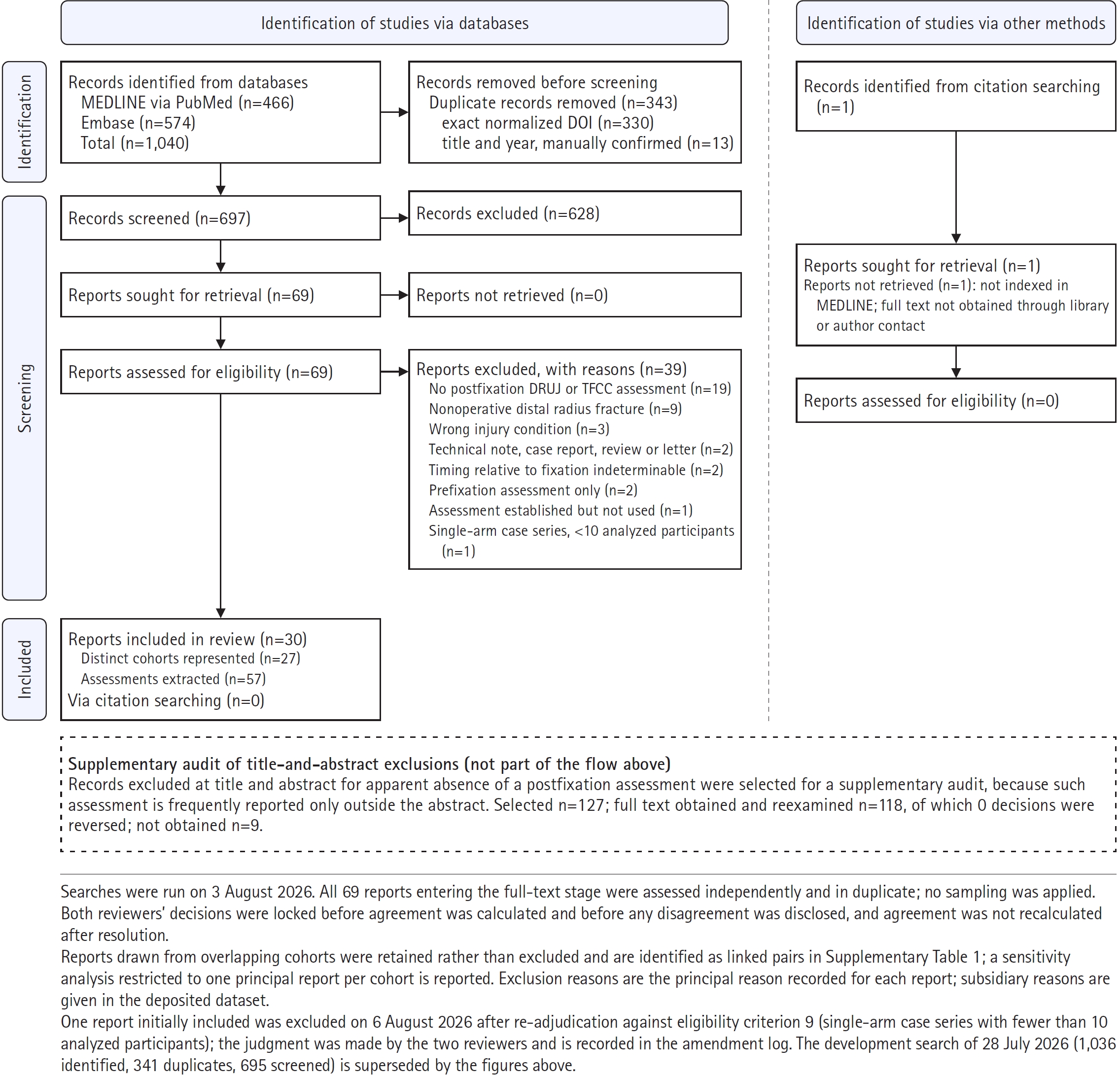
Preferred Reporting Items for Systematic Reviews and Meta-Analyses (PRISMA) 2020 flow diagram for identification, screening, and inclusion of reports. Records identified through database searches and citation searching are shown separately. The audit of title and abstract exclusions shown below the flow diagram is not part of the PRISMA flow: records excluded at title and abstract for apparent absence of a postfixation assessment were reexamined at full text, and no decision was reversed. DRUJ, distal radioulnar joint; TFCC, triangular fibrocartilage complex.
Table 1.
Characteristics of the 30 included reports
Table 2.
Reporting of residual DRUJ instability at report level (n=30)
Table 3.
Characteristics of the 57 assessments, overall and by temporal phase
Table 4.
The three prespecified stratifications of the primary and coprimary outcomes
Values are presented as number (%). The TFCC verification rows are definitional by construction and are not interpreted as an empirical association. A report that did not verify the structural lesion did not measure one of the two variables and was therefore classified as instability addressed without structural verification by the coding rule itself, which is why that column reads 15 (100). The rows are reported because the stratification was prespecified. Item 5 is reported in the same four categories as in Table 2: reports containing no assessment made in a treatment-decision context are shown as not applicable and are not counted as an absent definition, so the four definition columns sum to the stratum denominator. Three reports whose direction of recruitment could not be determined were excluded from the prospective-retrospective stratification, so that stratum totals 27 rather than 30. TFCC, triangular fibrocartilage complex.
Table 5.
Agreement between the two reviewers, calculated on locked data before disclosure (extraction stage: the 31 reports included at the time of locking)
Table 6.
Candidate minimum reporting elements and their empirical basis in the present sample
- 1. Xiao AX, Graf AR, Dawes A, Daley C, Wagner ER, Gottschalk MB. Management of acute distal radioulnar joint instability following a distal radius fracture: a systematic review and meta-analysis. J Hand Surg Glob Online 2021;3:133-8.ArticlePubMedPMC
- 2. van Rossenberg LX, Beeres FJ, van Heijl M, et al. Operative versus non-operative treatment of ulnar styloid process base fractures: a systematic review and meta-analysis. Eur J Trauma Emerg Surg 2024;50:2843-54.ArticlePubMedPMCPDF
- 3. Cerezal L, Del Pinal F, Atzei A, et al. Interdisciplinary consensus statements on imaging of DRUJ instability and TFCC injuries. Eur Radiol 2023;33:6322-38.ArticlePubMedPDF
- 4. Page MJ, McKenzie JE, Bossuyt PM, et al. The PRISMA 2020 statement: an updated guideline for reporting systematic reviews. BMJ 2021;372:n71.ArticlePubMedPMC
- 5. Rethlefsen ML, Kirtley S, Waffenschmidt S, et al. PRISMA-S: an extension to the PRISMA statement for reporting literature searches in systematic reviews. Syst Rev 2021;10:39.ArticlePubMedPMC
- 6. McGowan J, Sampson M, Salzwedel DM, Cogo E, Foerster V, Lefebvre C. PRESS peer review of electronic search strategies: 2015 guideline statement. J Clin Epidemiol 2016;75:40-6.ArticlePubMed
- 7. Baek S, Oh SB, Lee JH, et al. Intraoperative evaluation of DRUJ instability through dorsal stress radiography in distal radius fractures. J Orthop Sci 2022;27:881-6.ArticlePubMed
- 8. Li C, Kong L, Shi X, Zhang Z, Lu J, Zhang B. Predictive factors of distal radioulnar joint instability after surgical treatment of distal radius fractures. Medicine (Baltimore) 2023;102:e36505. ArticlePMC
- 9. Huang YM, Chen CY, Lin KC, et al. Using trident distal radial locking plate to fix the fracture of distal radius volar rim. J Chin Med Assoc 2023;86:426-30.ArticlePMC
- 10. Goorens CK, Van Eetvelde G, Debaenst N, Van Royen K, Goubau J. Headless screw fixation of unstable ulnar styloid base fractures after distal radial fractures fixation. J Hand Microsurg 2024;16:100066.ArticlePubMedPMC
- 11. Bakker D, Derksen BM, Kramer SB, Cleffken BI, Schep NW. Concomitant ligament injuries can be left untreated during surgery of distal radial fractures. J Hand Surg Eur Vol 2023;48:1068-73.ArticlePubMedPDF
- 12. Jiang P, Jiang H, Han F, Liu S, Qu W. Arthroscopic capsular suture benefits the clinical prognosis of distal radius fracture with DRUJ instability. BMC Surg 2025;25:327.ArticlePubMedPMCPDF
- 13. Wang WT, Chen CS. Treatment of the distal forearm fracture by volar dual window approach. Life (Basel) 2024;14:972.ArticlePubMedPMC
- 14. Wong KC, Wu M, Zai Q, et al. Concomitant ulnar styloid fractures in distal radius osteosynthesis does not impact radiographic outcomes, ulnar sided symptoms and patient outcomes. Malays Orthop J 2023;17:142-8.ArticlePubMedPMC
- 15. García-Ruano ÁA, Najarro-Cid F, Jiménez-Martín A, Gómez de los Infantes-Troncoso JG, Sicre-González M. Arthroscopic knotless anchor repair of triangular fibrocartilage in distal radius fracture. Rev Esp Cir Ortop Traumatol 2015;59:260-5.ArticlePubMed
- 16. Park YC, Shin SC, Kang HJ, Jeon SY, Song JH, Kim JS. Arthroscopic foveal repair of the triangular fibrocartilage complex improved the clinical outcomes in patients with persistent symptomatic distal radio-ulnar joint instability after plate fixation of distal radius fractures: minimum 2-year follow-up. Arthroscopy 2022;38:1146-53.ArticlePubMedPDF
- 17. Kim KW, Lee CH, Choi JH, Ahn JM, Gong HS. Distal radius fracture with concomitant ulnar styloid fracture: does distal radioulnar joint stability depend on the location of the ulnar styloid fracture? Arch Orthop Trauma Surg 2023;143:839-45.ArticlePubMedPDF
- 18. Afifi A, Mansour A. Is it necessary to fix basal fractures of the ulnar styloid after anterior plate fixation of distal radius fractures? A randomized controlled trial. J Hand Surg Eur Vol 2023;48:544-50.ArticlePubMedPDF
- 19. Yin CY, Huang HK, Fufa D, Wang JP. Radius distraction during volar plating of distal radius fractures may improve distal radioulnar joint stability at minimum 3-year follow-up: a retrospective case series study. BMC Musculoskelet Disord 2022;23:181.ArticlePubMedPMCPDF
- 20. Sato K, Murakami K, Mimata Y, Numata N, Shiraishi H, Doita M. Conservative treatment of distal ulna metaphyseal fractures associated with distal radius fractures in elderly people. Orthop Traumatol Surg Res 2018;104:1101-5.ArticlePubMed
- 21. Vermeuil M, Le Baron M, Flecher X, Argenson JN, Lami D, de Villeneuve Bargemon JB. Computed tomography-based predictors of ulnar-sided complications after distal radius fracture fixation. Orthop Traumatol Surg Res 2026;112:104652.ArticlePubMed
- 22. Lamas C, Arenas J, Almenara M, Rojas R, Fa-Binefa M, Toro-Aguilera A. Is pronator quadratus muscle repair required after anterior plate fixation for distal radial fractures? A prospective randomized comparative study. J Hand Surg Eur Vol 2024;49:334-40.ArticlePubMedPDF
- 23. Lee SK, Kim KJ, Cha YH, Choy WS. Conservative treatment is sufficient for acute distal radioulnar joint instability with distal radius fracture. Ann Plast Surg 2016;77:297-304.ArticlePubMed
- 24. Fok MW, Fang CX, Lau TW, Fung YK, Fung BK, Leung FK. The status of triangular fibrocartilage complex after the union of distal radius fractures with internal plate fixation. Int Orthop 2018;42:1917-22.ArticlePubMedPDF
- 25. Gong HS, Cho HE, Kim J, Kim MB, Lee YH, Baek GH. Surgical treatment of acute distal radioulnar joint instability associated with distal radius fractures. J Hand Surg Eur Vol 2015;40:783-9.ArticlePubMedPDF
- 26. Li S, Wang H, Su B, et al. Impact of ulnar styloid fractures on the treatment effect of distal radius fractures with volar plate fixation: a case control study. Indian J Orthop 2020;54:75-82.ArticlePubMedPMCPDF
- 27. Im J, Kang SJ, Lee SJ. A comparative study between conservative and surgical treatments of triangular fibrocartilage complex injury of the wrist with distal radius fractures. Clin Orthop Surg 2021;13:105-9.ArticlePubMedPMCPDF
- 28. Huajun J, Sida L, Peilong J, Borui Z, Jingjing Y, Wei Q. Evaluation of severe radial translation of distal radius fractures which is a potential cause of distal radioulnar joint instability. J Plast Surg Hand Surg 2026;61:104-9.ArticlePubMedPDF
- 29. Johandi F, Sechachalam S. Clinical and functional outcome of open primary repair of triangular fibrocartilage complex tears associated with distal radius fractures. J Orthop Surg (Hong Kong) 2017;25:2309499017690984.ArticlePDF
- 30. Tian Y, Dong J, Wu Y, et al. Comparative study of short-term effectiveness of three surgical methods for ulnar styloid base fracture complicated with triangular fibrocartilage complex injury. Zhongguo Xiu Fu Chong Jian Wai Ke Za Zhi 2024;38:968-75.ArticlePubMedPMC
- 31. Park J, Gil YW, Lee YS, Lee CH. Primary arthroscopy-assisted foveal repair of triangular fibrocartilage complex associated with acute distal radius fractures in young adults. J Wrist Surg 2025;14:214-25.ArticlePubMed
- 32. Ishimatsu M, Oda T, Yamanaka Y, Takahashi K, Hamada S, Wada T. Frequency and outcomes of distal radioulnar joint dislocation associated with distal radius fractures in the elderly. J Hand Surg Glob Online 2026;8:100882.ArticlePubMed
- 33. Vlcek M, Pech J, Musil V, Stingl J. Conservative and surgical treatment for distal ulna fractures associated with distal radius fractures. Acta Chir Orthop Traumatol Cech 2015;82:412-7.ArticlePubMed
- 34. Meluzinova P, Kopp L, Drac P, Edelmann K, Obruba P. Comparison of short-term results of conservative versus operative treatment of distal ulna fractures associated with distal radius fracture treated by plate osteosynthesis. Acta Chir Orthop Traumatol Cech 2017;84:182-8.PubMed
- 35. Meluzinova P, Kopp L, Drac P, Edelmann K, Obruba P. Plate osteosynthesis of distal ulna fractures with associated distal radius fractures treated by open reduction and internal fixation: short-term functional and radiographic results. Acta Chir Orthop Traumatol Cech 2015;82:369-76.ArticlePubMed
- 36. Abdelgaid SM, Abdelazeem ME, Alsharkawy W. Fragment-specific fixation of complex distal radial fractures with small intraarticular fragments; volar locked plate augmented with Kirschner wires. Curr Orthop Pract 2015;26:306-13.Article
- 37. Lindau T, Hagberg L, Adlercreutz C, Jonsson K, Aspenberg P. Distal radioulnar instability is an independent worsening factor in distal radial fractures. Clin Orthop Relat Res 2000;376:229-35.Article
- 38. Lindau T, Runnquist K, Aspenberg P. Patients with laxity of the distal radioulnar joint after distal radial fractures have impaired function, but no loss of strength. Acta Orthop Scand 2002;73:151-6.Article
- 39. Hrobjartsson A, Pildal J, Chan AW, Haahr MT, Altman DG, Gotzsche PC. Reporting on blinding in trial protocols and corresponding publications was often inadequate but rarely contradictory. J Clin Epidemiol 2009;62:967-73.ArticlePubMed
- 40. Chan AW, Hrobjartsson A, Haahr MT, Gotzsche PC, Altman DG. Empirical evidence for selective reporting of outcomes in randomized trials: comparison of protocols to published articles. JAMA 2004;291:2457-65.ArticlePubMed
- 41. Bertizzolo L, Bossuyt P, Atal I, Ravaud P, Dechartres A. Disagreements in risk of bias assessment for randomized controlled trials included in more than one Cochrane systematic reviews: a research on research study using cross-sectional design. BMJ Open 2019;9:e028382. ArticlePubMedPMC
References
Figure & Data
REFERENCES
Citations
Citations to this article as recorded by 
 ePub Link
 Cite
 XML Download
Definitions and assessment of residual distal radioulnar joint instability after operative fixation of distal radius fractures: a methodological systematic review
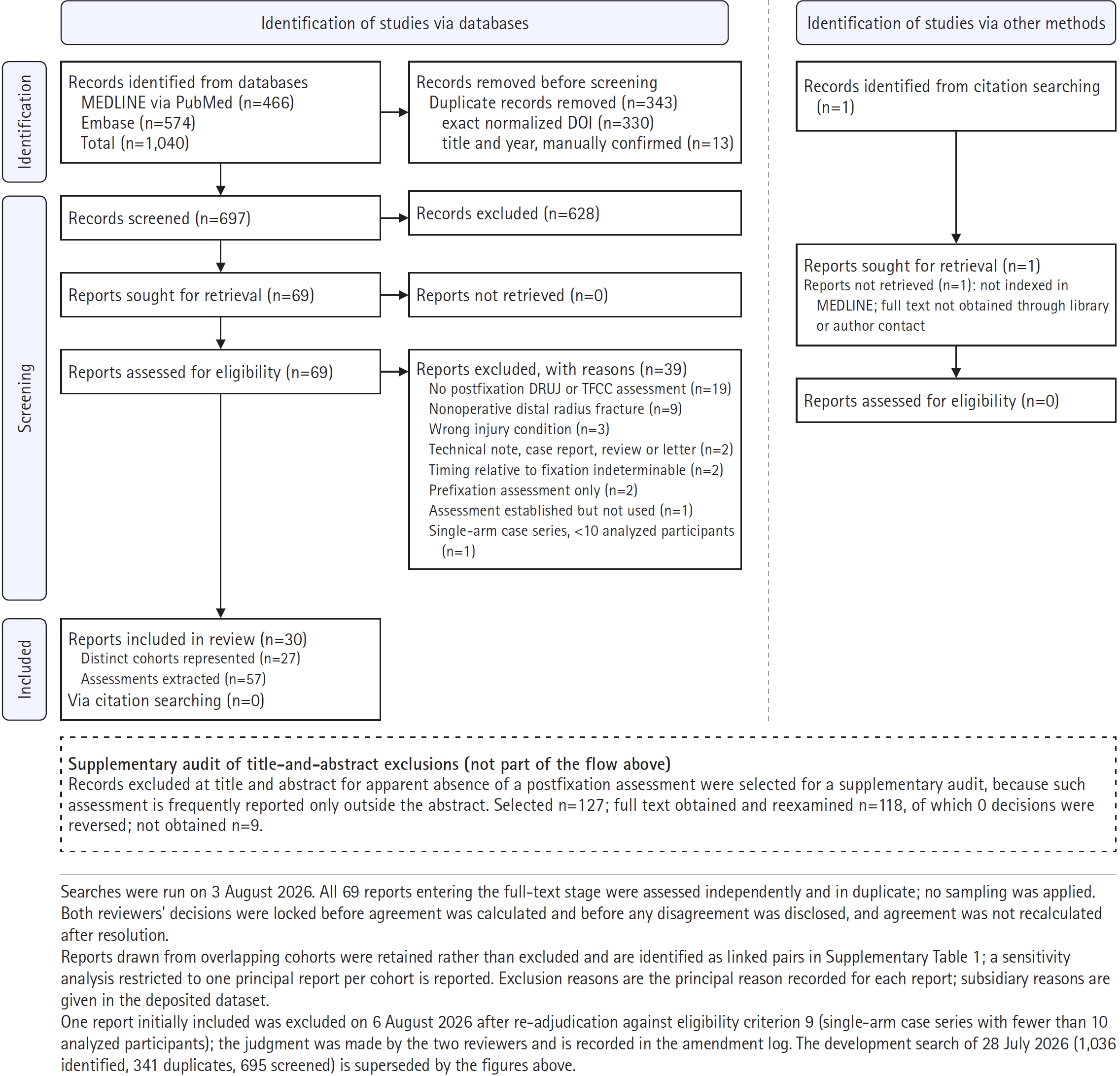
Fig. 1. Preferred Reporting Items for Systematic Reviews and Meta-Analyses (PRISMA) 2020 flow diagram for identification, screening, and inclusion of reports. Records identified through database searches and citation searching are shown separately. The audit of title and abstract exclusions shown below the flow diagram is not part of the PRISMA flow: records excluded at title and abstract for apparent absence of a postfixation assessment were reexamined at full text, and no decision was reversed. DRUJ, distal radioulnar joint; TFCC, triangular fibrocartilage complex.
Fig. 1.
Definitions and assessment of residual distal radioulnar joint instability after operative fixation of distal radius fractures: a methodological systematic review
| Characteristic | No. (%) |
|---|---|
| Year of publication | |
| 2015–2020 | 11 (36.7) |
| 2021–2026 | 19 (63.3) |
| Study design | |
| Case series | 10 (33.3) |
| Retrospective cohort | 10 (33.3) |
| Prospective cohort | 5 (16.7) |
| Randomized trial | 4 (13.3) |
| Comparative study | 1 (3.3) |
| Direction of recruitment and data collection | |
| Retrospective | 17 (56.7) |
| Prospective | 10 (33.3) |
| Could not be determined | 3 (10.0) |
| Language of publication | |
| English | 26 (86.7) |
| Czech | 3 (10.0) |
| Chinese | 1 (3.3) |
| Assessments contributed per report | |
| One | 11 (36.7) |
| Two | 12 (40.0) |
| Three | 6 (20.0) |
| Four | 1 (3.3) |
| All analyzed participants had an operatively fixed distal radius fracture | 30 (100) |
| Contained at least one assessment made in a treatment-decision context | 24 (80.0) |
| Characteristic | No. (%) |
|---|---|
| Operational definition in the treatment-decision context (Item 5)—all 30 reports | |
| Explicit (both the assessment method and the criterion distinguishing stable from unstable were stated) | 12 (40.0) |
| Partial (one of the two was stated) | 8 (26.7) |
| None (neither was stated) | 4 (13.3) |
| Not applicable (the report contains no assessment made in a treatment-decision context) | 6 (20.0) |
| The same item among the 24 reports that contained such an assessment | |
| Explicit | 12 (50.0) |
| Partial | 8 (33.3) |
| None | 4 (16.7) |
| Location of the information on which the definition level was assigned (Item 6) | |
| Methods | 24 (80.0) |
| Results only | 4 (13.3) |
| Could not be located unambiguously | 2 (6.7) |
| Relationship between structural TFCC lesion and functional instability (Item 11) | |
| R1: distinct constructs | 14 (46.7) |
| R2: TFCC lesion used as a surrogate for instability | 0 |
| R3: conflated | 1 (3.3) |
| R4: instability addressed without structural verification | 15 (50.0) |
| R5: unclear | 0 |
| TFCC verification method (Item 9a) | |
| Not verified | 15 (50.0) |
| Arthroscopy | 7 (23.3) |
| Open inspection | 3 (10.0) |
| More than one method | 3 (10.0) |
| Magnetic resonance imaging | 2 (6.7) |
| Extent of verification (Item 9b) | |
| All participants | 9 (30.0) |
| Selected subgroup | 5 (16.7) |
| None | 15 (50.0) |
| Unclear | 1 (3.3) |
| Use of ulnar styloid status (Item 10) | |
| Not used | 15 (50.0) |
| Indication for adjunctive treatment only | 15 (50.0) |
| Both evidence of instability and indication for treatment | 0 |
| Evidence of instability only | 0 |
| Threshold linking instability to treatment (Item 16) | |
| Linked to a judgment, but no threshold stated | 9 (30.0) |
| Nonoperational or vague threshold | 7 (23.3) |
| Explicit threshold linked to treatment | 6 (20.0) |
| No link to treatment | 5 (16.7) |
| Not applicable | 3 (10.0) |
| Definition of persistent or recurrent instability at follow-up (Item 17) | |
| Explicit | 7 (23.3) |
| Partial | 12 (40.0) |
| None | 11 (36.7) |
| Characteristic | All (n=57) | Intraoperative (n=25) | Postoperative (n=32) | Final follow-up (n=27) |
|---|---|---|---|---|
| Assessment method (more than one code may apply) | ||||
| Ballottement or shuck test | 25 (43.9) | 9 (36.0) | 16 (50.0) | 12 (44.4) |
| Radioulnar stress, drawer or shift test | 13 (22.8) | 8 (32.0) | 5 (15.6) | 4 (14.8) |
| Not specified or not reported | 11 (19.3) | 5 (20.0) | 6 (18.8) | 6 (22.2) |
| Other, specified | 7 (12.3) | 0 | 7 (21.9) | 6 (22.2) |
| Piano-key test | 5 (8.8) | 0 | 5 (15.6) | 5 (18.5) |
| Unnamed intraoperative manual assessment | 2 (3.5) | 2 (8.0) | 0 | 0 |
| Stress radiography | 1 (1.8) | 1 (4.0) | 0 | 0 |
| Not performed | 1 (1.8) | 1 (4.0) | 0 | 0 |
| Level of the positive criterion | ||||
| Explicit | 22 (38.6) | 12 (48.0) | 10 (31.3) | 7 (25.9) |
| Vague | 25 (43.9) | 9 (36.0) | 16 (50.0) | 14 (51.9) |
| None stated | 10 (17.5) | 4 (16.0) | 6 (18.8) | 6 (22.2) |
| Testing conditions | ||||
| Contralateral comparison used | 23 (40.4) | 11 (44.0) | 12 (37.5) | 7 (25.9) |
| Contralateral comparison not reported | 34 (59.6) | 14 (56.0) | 20 (62.5) | 20 (74.1) |
| Contralateral comparison explicitly stated not to have been used | 0 | 0 | 0 | 0 |
| Forearm position reported | 21 (36.8) | 13 (52.0) | 8 (25.0) | 5 (18.5) |
| Anesthetic state reported | 55 (96.5) | 25 (100) | 30 (93.8) | 25 (92.6) |
| Composite judgment (more than one test combined) | 5 (8.8) | 0 | 5 (15.6) | 4 (14.8) |
| Frequency | ||||
| Descriptive frequency extractable | 44 (77.2) | 15 (60.0) | 29 (90.6) | 24 (88.9) |
| Prevalence estimate comparable across reports | 9 (15.8) | 6 (24.0) | 3 (9.4) | 2 (7.4) |
| Stratum | No. | Definition explicit | Definition partial | Definition none | Definition not applicable | R1 distinct | R4 instability only | R3 conflated |
|---|---|---|---|---|---|---|---|---|
| 2015–2020 | 11 | 3 (27.3) | 3 (27.3) | 2 (18.2) | 3 (27.3) | 5 (45.5) | 6 (54.5) | 0 |
| 2021–2026 | 19 | 9 (47.4) | 5 (26.3) | 2 (10.5) | 3 (15.8) | 9 (47.4) | 9 (47.4) | 1 (5.3) |
| TFCC verified | 15 | 7 (46.7) | 5 (33.3) | 1 (6.7) | 2 (13.3) | 14 (93.3) | 0 | 1 (6.7) |
| TFCC not verified | 15 | 5 (33.3) | 3 (20.0) | 3 (20.0) | 4 (26.7) | 0 | 15 (100) | 0 |
| Prospective | 10 | 5 (50.0) | 1 (10.0) | 1 (10.0) | 3 (30.0) | 4 (40.0) | 5 (50.0) | 1 (10.0) |
| Retrospective | 17 | 7 (41.2) | 5 (29.4) | 2 (11.8) | 3 (17.6) | 9 (52.9) | 8 (47.1) | 0 |
| Stage and item | Agreement (%) | κ (95% CI where calculated) |
|---|---|---|
| Eligibility (69 reports) | ||
| Eligibility decision, three categories | 94.2 | 0.88 (0.77–0.99), unweighted |
| Principal exclusion code, among reports both reviewers excluded | 78.4 | 0.71 (0.54–0.88), unweighted |
| Extraction, all 31 reports included at locking | ||
| Definition level (Item 5) | 80.6 | 0.78 (0.62–0.95), linear-weighted |
| Lesion-instability relationship (Item 11) | 83.9 | 0.71 (0.49–0.92), unweighted |
| Follow-up definition level (Item 17) | 74.2 | 0.60 (0.36–0.83), linear-weighted |
| Extraction, assessment-level records (51 matched pairs from 58 and 56 records) | ||
| Contralateral comparison (Item 15) | 72.5 | 0.40 (0.15–0.65), binary contrast |
| Extraction, validation subset of 8 reports extracted independently | ||
| Location of the definition (Item 6) | 87.5 | 0.71 |
| TFCC verification method (Item 9a) | 75.0 | 0.67 |
| Extent of TFCC verification (Item 9b) | 62.5 | 0.49 |
| Use of ulnar styloid status (Item 10) | 100.0 | 1.00 |
| Threshold linking instability to treatment (Item 16) | 87.5 | 0.83 |
| No. | Element | Empirical basis in the present sample |
|---|---|---|
| 1 | Name the assessment maneuver used | Method unidentifiable in 19.3% of assessments |
| 2 | State the criterion that defines a positive result, operationally | Vague or absent in 61.4% of assessments |
| 3 | State the testing conditions—whether a contralateral comparison was made including when it was not, forearm position, anesthetic state | Contralateral comparison reported in 40.4% of assessments and never explicitly denied; forearm position not reported in 63.2%; anesthetic state not reported in 3.5% |
| 4 | State the time point relative to fixation, and whether the assessment was intraoperative or postoperative | A scheduled postoperative time point could not be identified in 12 of the 32 postoperative assessments, which reported only a mean follow-up interval |
| 5 | State whether the TFCC was structurally verified, by what method, and in how many participants | Not verified in 50% of reports; extent unclear in one of the 15 that did verify |
| 6 | State the numerator and the denominator for any frequency reported | A comparable estimate was available from only 15.8% of assessments |
| 7 | State the definition applied at follow-up separately from the definition applied initially | Both stated in five of 30 reports |
| 8 | State the threshold at which the finding changed management | Explicit threshold in 20% of reports |
Table 1. Characteristics of the 30 included reports
Table 2. Reporting of residual DRUJ instability at report level (n=30)
DRUJ, distal radioulnar joint; TFCC, triangular fibrocartilage complex.
Table 3. Characteristics of the 57 assessments, overall and by temporal phase
Values are presented as number (%) of the assessments in that column. The final follow-up column is a subset of the postoperative column, not a fourth group, so the columns are not mutually exclusive and do not sum to 57. Percentages are of the column denominator.
Table 4. The three prespecified stratifications of the primary and coprimary outcomes
Values are presented as number (%). The TFCC verification rows are definitional by construction and are not interpreted as an empirical association. A report that did not verify the structural lesion did not measure one of the two variables and was therefore classified as
Table 5. Agreement between the two reviewers, calculated on locked data before disclosure (extraction stage: the 31 reports included at the time of locking)
CI, confidence interval; TFCC, triangular fibrocartilage complex.
Table 6. Candidate minimum reporting elements and their empirical basis in the present sample
TFCC, triangular fibrocartilage complex.


