
 E-submission
 KOTA
 TOTA
 TOTS

Articles
- Page Path
- HOME > > Ahead-of print articles > Article
-
Original Article
- Proximal screw number and neck-shaft angle after locking plate fixation of proximal humerus fractures at a single center in Korea: a retrospective cohort study
- Dong Uk Jin1, Se Ho Kang1, Yeong Chan Kim1, Kyu-Hak Jung2, Sang-Pil So1
-
DOI: https://doi.org/10.12671/jmt.2026.00276
Published online: October 20, 2026
1Department of Orthopedic Surgery, Gil Medical Center, Gachon University, Incheon, Korea
2Department of Orthopedic Surgery, Yeson Hospital, Bucheon, Korea
- Correspondence to: Sang-Pil So Department of Orthopedic Surgery, Gil Medical Center, Gachon University, 21 Namdong-daero 774beon-gil, Namdong-gu, Incheon 21565, Korea Tel: +82-32-460-3384 Email: cufftear@gmail.com
• Received: August 7, 2026 • Revised: August 27, 2026 • Accepted: August 31, 2026
© 2026 The Korean Orthopaedic Trauma Association
This is an Open Access article distributed under the terms of the Creative Commons Attribution Non-Commercial License (http://creativecommons.org/licenses/by-nc/4.0/) which permits unrestricted noncommercial use, distribution, and reproduction in any medium, provided the original work is properly cited.
- 76 Views
- 2 Download


Abstract
-
Background The neck-shaft angle (NSA) may decrease between the immediate postoperative assessment and radiographic union after locking plate fixation of proximal humerus fractures. However, the relationship between the number of proximal humeral head screws and postoperative NSA remains unclear. This study compared postoperative NSA and the change in NSA (ΔNSA) among groups defined by the number of proximal screws.
-
Methods This retrospective cohort study included consecutive patients who underwent locking plate fixation of a proximal humerus fracture between August 2025 and June 2026. Patients were classified into three groups according to the number of proximal screws: ≤7, 8, or 9. NSA was measured preoperatively, immediately postoperatively, and at radiographic union, hereafter referred to as the final assessment. Final NSA, ΔNSA, the proportions of patients with varus malalignment (final NSA <120°) and angular loss of reduction (ΔNSA ≤−10°), and complication rates were compared among groups. Trends across increasing screw numbers were also assessed.
-
Results Nineteen patients were evaluated: nine in the ≤7-screw group, four in the 8-screw group, and six in the 9-screw group. Immediate postoperative NSA was 140.1°±5.7°, 136.2°±11.8°, and 134.0°±6.2° in the three groups, respectively; final NSA was 131.6°±9.2°, 129.5°±16.1°, and 130.2°±8.3°; and ΔNSA was −8.6°±8.8°, −6.8°±4.6°, and −3.8°±5.2°. None of these outcomes differed significantly among groups (all P>0.05). Varus malalignment occurred in 22.2%, 25.0%, and 16.7% of patients, respectively (P=0.944). Angular loss of reduction occurred in 44.4%, 25.0%, and 0%, respectively; neither the overall group difference (P=0.159) nor the trend across groups (P=0.056) reached statistical significance. Complication rates also did not differ significantly among groups.
-
Conclusions In this small retrospective cohort, the number of proximal screws was not significantly associated with final NSA or ΔNSA. Although the proportion of patients with angular loss of reduction decreased numerically as the screw number increased, this trend was not statistically significant and should be regarded as exploratory.
-
Level of evidence III.
Introduction
Proximal humerus fracture (PHF) is the third most common osteoporotic fracture following proximal femur and distal radius fractures [1,2]. These fractures can be treated either conservatively or operatively, and operative options include locking plate fixation, intramedullary nailing, and shoulder arthroplasty [3-7]. Locking plates for PHFs have been widely used and are associated with a high union rate [8,9]. However, even after locking plate fixation, a decrease in the neck-shaft angle (NSA) has been reported between the immediate postoperative period and the time of bony union [10]. Several factors—including the number and position of calcar screws, the quality of initial reduction, medial hinge/calcar support, and patient bone quality—have been reported to be associated with a decrease in NSA or varus collapse after locking plate fixation [9,11-13]. A previous biomechanical study investigated the optimal number of screws inserted into the humeral head, but the evidence did not simply indicate that more screws are better; similarly, in previous clinical studies, the number of screws in the humeral head has not been significantly associated with loss of reduction or varus collapse [14,15]. Nevertheless, studies specifically focusing on the relationship between the number of screws in the humeral head and postoperative NSA or the change in NSA after locking plate fixation remain limited.
The primary aim was to compare final NSA and the change in NSA (ΔNSA) among proximal screw-number groups. The secondary aim was to compare complication rates according to the number of proximal screws. We hypothesized that the final NSA would be higher and that the decrease in NSA would be smaller in patients with a greater number of proximal screws.
Methods
We conducted this study in compliance with the principles of the Declaration of Helsinki. The study protocol was reviewed and approved by the Institutional Review Board (IRB) of Gil Medical Center (No. GAIRB 2026-284). Informed consent was waived by the IRB due to the retrospective nature of the study.
This single-center, retrospective cohort study included consecutive patients aged 18 years or older who underwent open reduction and internal fixation with a locking plate for a PHF involving the surgical neck by two upper-extremity fellowship-trained orthopedic surgeons (SPS and DUJ).
This study was conducted at Gil Medical Center, Incheon, Korea. Operations were performed from August 2025 through June 2026, and follow-up and data collection continued through August 2026.
Fractures were classified according to the Neer classification system [16]. Patients were included if they had plain radiographs obtained preoperatively, immediately postoperatively, and at the time of radiographic union, defined as bridging callus visible across at least three cortices on two orthogonal radiographic views. Patients were excluded if they had (1) isolated greater tuberosity (GT) or lesser tuberosity fracture, (2) a history of previous surgery on the ipsilateral shoulder, (3) a pathologic or open fracture, (4) failure to achieve radiographic union, including early fixation failure requiring revision surgery or death prior to union assessment, or (5) inadequate image quality precluding precise radiological assessment. All fixations were performed using one of two locking plate systems: the PHILOS (proximal humeral internal locking system, DePuy Synthes) or the ARIX Humerus System (Jeil Medical Corp.). Both systems are anatomically pre-contoured, angular-stable locking plates with combination-type proximal screw holes accommodating up to nine locking screws in the humeral head. The choice of implant was based on surgeon preference and institutional availability.
The exposure variable was the number of proximal humeral head screws, categorized as ≤7, 8, or 9. The coprimary outcomes were final NSA and ΔNSA. Secondary outcomes were varus malalignment, angular loss of reduction, screw-related complications, and avascular necrosis. Immediate postoperative NSA served as the postoperative reference measurement for calculating ΔNSA.
Patients were originally classified according to the exact number of proximal (humeral head) screws (6, 7, 8, or 9). Because only two patients received 6 screws, these patients were combined with the 7-screw group into a single ≤7-screw category, resulting in three groups for analysis (≤7, 8, and 9 screws). ΔNSA was defined as the difference in NSA between the final and immediate postoperative assessments (final NSA – immediate postoperative NSA). A final NSA <120° was defined as varus malalignment, and a ΔNSA ≤–10° was defined as angular loss of reduction. Postoperative NSA, ΔNSA, the proportions of varus malalignment, angular loss of reduction, and complication rates were compared among the three groups, and trends according to increasing screw number were analyzed.
Patient demographics and radiologic images were retrieved from electronic medical records for assessment. The NSA was measured using a previously described technique by Agel et al. [17] on anteroposterior shoulder radiographs at three time points: preoperatively, immediately postoperatively, and at the time of radiographic union (hereafter referred to as the final assessment) (Fig. 1). All NSA measurements used in the primary analysis, including the immediate postoperative NSA, were performed by a single observer (SPS, an upper-extremity fellowship-trained surgeon). To assess measurement reliability, preoperative and final NSA were additionally measured by a second observer (YCK, a senior orthopedic resident), and observer 1 (SPS) repeated the preoperative and final NSA measurements after a 2-week interval, blinded to the initial measurements. Intraobserver reliability was calculated from observer 1’s two measurements, and interobserver reliability was calculated between observer 1’s initial measurement and observer 2’s measurement, using a two-way random effects, absolute-agreement, single-measures intraclass correlation coefficient (ICC[2,1]).
Confounding by indication arose because surgeons selected screw number according to fracture severity. Consecutive enrollment and predefined criteria reduced selection bias, but excluding failures before union may cause survivor bias.
No formal sample size calculation was performed. All consecutive eligible patients treated during the study period were included; therefore, the study size was determined by available cases meeting the eligibility and radiographic follow-up criteria.
Continuous variables are presented as mean±standard deviation and categorical variables as number (%). Intra- and interobserver reliability of NSA measurements was assessed using ICCs [18]. Continuous variables, including baseline demographic and fracture characteristics and NSA at each time point, were compared among the three screw-number groups using the Kruskal-Wallis test; when a significant difference was found, post-hoc pairwise comparisons were performed using the Mann-Whitney U test with a Bonferroni-corrected significance threshold (P<0.0167). Independently of statistical significance, effect sizes (epsilon-squared for omnibus comparisons; Cohen’s d and 95% confidence intervals (CIs) for the mean difference between the ≤7- and 9-screw groups) were additionally calculated for the primary continuous outcomes to aid interpretation of the magnitude of observed differences. Because the three groups were ordinal, the Jonckheere-Terpstra test was additionally used to assess a monotonic trend across the ordered groups for continuous outcome and surgical variables (NSA at each time point, calcar screw number, and time to union). Categorical variables, including baseline demographic and fracture characteristics, the proportions of patients with varus malalignment and angular loss of reduction, and complication rates detected through radiographic union, were compared among the three groups using the Fisher-Freeman-Halton exact test; when a significant difference was found, post-hoc pairwise comparisons were performed using Fisher exact test with a Bonferroni-corrected significance threshold (P<0.0167). The Cochran-Armitage trend test was used to assess a trend across the ordered groups for the binary outcome variables (varus malalignment, angular loss of reduction, and complication rates detected through radiographic union). The change in NSA from the immediate postoperative assessment to the final assessment within each group was assessed using the Wilcoxon signed-rank test. Because of the small sample size and limited number of outcome events, multivariable adjustment was not performed; all between-group comparisons were unadjusted. All statistical analyses were performed using IBM SPSS for macOS, ver. 31 (IBM Corp.), with P<0.05 considered statistically significant.
Results
Of the 24 patients initially identified, five were excluded: two had isolated GT fractures, two underwent revision surgery due to early fixation failure prior to achieving radiographic union, and one died before union could be radiographically assessed. Therefore, a total of 19 patients were enrolled. According to proximal screw numbers, nine, four, and six patients were classified into ≤7-, 8-, and 9-screw groups, respectively; the ≤7-screw group comprised two patients with six screws and seven patients with seven screws. All 19 patients achieved radiographic union and the mean time to radiographic union was 4.2±1.5 months (range, 2–6 months) overall and did not differ significantly among the ≤7-, 8-, and 9-screw groups (4.3±1.7, 4.0±1.4, and 4.0±1.6 months, respectively; P=0.905; trend P=0.647). There were no significant differences among the three screw-number groups in demographics or fracture characteristics, except for a significantly higher rate of medial metaphyseal comminution in the 8-screw group compared with the ≤7-screw group (post-hoc P=0.007). Regarding surgical characteristics, the distribution of plate type did not differ significantly among groups (P=0.106), whereas the number of calcar screws differed significantly (P=0.028; trend P=0.040), with all patients in the 9-screw group receiving two calcar screws; however, no individual pairwise comparison reached significance after Bonferroni correction. Detailed baseline characteristics are summarized in Table 1.
Main results
The ICCs for intra- and interobserver reliability of NSA measurements were 0.947 (95% CI, 0.898–0.971) and 0.924 (95% CI, 0.859–0.960), respectively. The mean immediate postoperative NSA was 140.1°±5.7°, 136.2°±11.8°, and 134.0°±6.2° in the ≤7-, 8-, and 9-screw groups, respectively, and did not differ significantly among groups, although a decreasing pattern was observed with increasing screw number (P=0.203; trend P=0.073; ε²=0.177) (Fig. 2). The mean difference between the ≤7- and 9-screw groups was 6.11° (95% CI, −0.62° to 12.85°; Cohen's d=1.03). The final NSA (131.6°±9.2°, 129.5°±16.1°, and 130.2°±8.3°, respectively) did not differ significantly among groups (P=0.812; trend P=0.647; ε²=0.023; mean difference between ≤7- and 9-screw groups, 1.39°; 95% CI, −8.68° to 11.46°; Cohen's d=0.16) (Fig. 2), nor did ΔNSA (−8.6°±8.8°, −6.8°±4.6°, and −3.8°±5.2°, respectively; P=0.731; trend P=0.517; ε²=0.035; mean difference, −4.72°; 95% CI, −13.42° to 3.98°; Cohen's d=0.62) (Fig. 3). Within each group, NSA decreased significantly from the immediate postoperative to the final assessment in the ≤7-screw group (P=0.012), while it did not reach statistical significance in the 8- and 9-screw groups (P=0.125 and P=0.156, respectively) (Fig. 2).
Varus malalignment occurred in two of nine (22.2%), one of four (25.0%), and one of six (16.7%) patients, respectively, with no significant difference (P=0.944) or trend (P=0.813) across groups (Fig. 4). Angular loss of reduction occurred in four of nine patients (44.4%) in the ≤7-screw group, one of four (25.0%) in the 8-screw group, and zero of six (0%) in the 9-screw group (Fig. 4). Neither the overall difference among groups (P=0.159) nor the Cochran-Armitage trend test (P=0.056) reached statistical significance.
Screw-related complications occurred in three of nine (33.3%), one of four (25.0%), and one of six (16.7%) patients in the ≤7-, 8-, and 9-screw groups, respectively, with no significant difference (P=0.818) or trend (P=0.471) across groups. All five screw-related complications involved partial screw pull-out from the humeral head; none required revision surgery. Avascular necrosis occurred in zero, one (25.0%), and zero patients, respectively (P=0.213; trend P=0.853); the single case of avascular necrosis was identified at 6 months postoperatively.
Discussion
This study compared the postoperative NSA and ΔNSA according to the number of proximal screws and showed that the number of proximal screws was not significantly associated with the final NSA, ΔNSA, varus malalignment, angular loss of reduction, or complication rates. In addition, NSA decreased from the immediate postoperative to the final assessment in all screw groups, while statistical significance was achieved only in the ≤7-screw group.
An important consideration in interpreting these findings is that the number of screws was determined by the operating surgeon’s judgment rather than by a standardized protocol, and fracture severity was not balanced among the groups. In particular, medial metaphyseal comminution was present in all four patients in the 8-screw group compared with only one of nine patients in the ≤7-screw group, and the 8-screw group also had a numerically lower preoperative NSA, although the difference was not statistically significant. Consistent with this imbalance, the immediate postoperative NSA showed a decreasing pattern with increasing screw number, although the trend was not statistically significant; the ≤7-screw group had the highest value. These observations suggest that surgeons may have used a greater number of screws in more severely comminuted or unstable fractures, in which anatomic reduction itself was more difficult to achieve, making it difficult to separate any independent effect of screw number from the influence of fracture severity. A related observation was that the number of calcar screws also differed significantly among the three groups, with all patients in the 9-screw group receiving the maximum of two calcar screws; however, calcar screw number was similar between the ≤7- and 8-screw groups despite their differing fracture severity, indicating that calcar screw fixation alone does not fully account for the differences observed across groups.
Despite this less favorable preoperative and immediate postoperative status in the 8-screw group, the rate of angular loss of reduction was numerically lower with increasing screw number, and the Cochran-Armitage trend test did not reach statistical significance—an exploratory secondary observation. This pattern suggests that angular loss of reduction may have been comparatively low in the 8-screw group despite a more severe preoperative fracture status and a calcar screw distribution similar to that of the ≤7-screw group, although this cannot be distinguished from chance given the small sample size and the fact that this trend involved only five events among 19 patients. Given the limited statistical power and this confounding by fracture severity, the observation should be regarded as hypothesis-generating rather than evidence of an association between screw number and reduction maintenance, and confirmation in a larger, multicenter cohort with more balanced fracture characteristics is required.
Varus malalignment after locking plate fixation of PHFs has been consistently associated with poor clinical outcomes [19-21]. In a large cohort of 685 patients with a minimum 2-year follow-up, Fleischhacker et al. [19] reported progressively lower Constant scores with increasing degrees of varus malposition. Dheenadhayalan et al. [20] reported that an NSA <120° was associated with poorer functional outcomes and more limited shoulder abduction. Similarly, Kantharaju et al. [21] reported that patients with NSA <126° had a significantly worse Constant score than those with a normal NSA. Given these clinical consequences, preventing varus malalignment—or, more fundamentally, preventing angular loss of reduction before it progresses to malalignment—is of considerable clinical importance.
Regarding the optimal number of proximal screws, a biomechanical study by Kim et al. [14] compared four-, six-, seven-, and nine-screw constructs and found that the seven-screw group had the numerically highest load to failure and stiffness, and the lowest structural failure rate. Post-hoc pairwise comparisons showed no significant difference between the seven- and nine-screw groups in load to failure or structural failure rate, suggesting a plateau effect beyond a certain screw number rather than a continuously increasing benefit. Consistent with this biomechanical plateau, previous clinical studies have not identified proximal screw number as a significant risk factor for varus malalignment or loss of fixation; Maddah et al. [15], for example, reported no significant difference in the mean number of screws between patients with and without loss of fixation. The present findings are consistent with this body of literature: within the range of screw numbers evaluated in this cohort, no significant association was observed between screw number and postoperative NSA, final NSA, ΔNSA, varus malalignment, angular loss of reduction, or complication rates.
A decrease in NSA between the immediate postoperative period and bony union has been consistently reported after locking plate fixation of PHFs, with most of this decrease occurring within the first 1 to 3 months postoperatively rather than progressing steadily thereafter [10,22]. Pawaskar et al. [10] serially measured NSA in elderly patients treated with locking plates and found that the NSA decreased from 133.6° immediately postoperatively to 129.8° at 3 months and 128.4° at final follow-up, with the majority of the loss occurring within the first 3 months. In the present study, a similar decreasing pattern was observed across all three screw-number groups, consistent with these previous reports, and a significant within-group decrease was observed only in the ≤7-screw group. However, this within-group finding does not permit a direct comparison between groups: the overall between-group comparison of ΔNSA was not significant, and the 8-screw group had limited statistical power to detect a significant within-group change regardless of its true magnitude.
This study has several limitations. First, the small sample size in this study limited the statistical power to detect differences among groups and increased the risk of a type II error; larger, multicenter studies are needed to confirm these findings. Second, although our institution uses a standardized radiographic technique for the shoulder anteroposterior view, the technique and arm position could not be fully controlled because of the retrospective design. Third, this study evaluated radiographic outcomes only, without correlating these findings with clinical or functional outcomes. Fourth, although there were no statistically significant differences in most baseline demographics and fracture characteristics among the three groups, the number of screws used was determined by the operating surgeon's judgment, rather than by randomization. However, randomizing this decision would not have been feasible or ethical, as it could compromise fixation quality and patient safety. Fifth, ΔNSA is partly dependent on the immediate postoperative starting value and may be affected by mathematical coupling and regression to the mean; a larger ΔNSA should therefore not be interpreted as an independent effect of screw number, and the similarity of final NSA across groups should be considered at least as informative. Sixth, patients who did not achieve radiographic union were not eligible for inclusion, as final NSA could not be measured without a union radiograph. This may have introduced selection bias by excluding patients at the greatest risk of reduction loss. Seventh, the surveillance period for complications, including avascular necrosis, was limited to the time of radiographic union, which may be insufficient to capture the full incidence of late-onset complications. Finally, proximal screw number was closely associated with implant type and calcar screw number, particularly because all patients in the 9-screw group received an ARIX plate and two calcar screws. Therefore, the independent effect of total screw number could not be isolated.
Despite these limitations, this study is meaningful in that it evaluated the relationship between the number of proximal screws and both the final NSA and the change in NSA with serial follow-up.
Findings may apply to similar adults treated with locking plates at specialized centers, but the single-center, small, selected union cohort limits broader generalizability.
Larger multicenter prospective cohorts should assess screw number while controlling for fracture severity, medial support, screw configuration, bone quality, and initial reduction.
Given the exploratory findings, proximal screw number alone should not guide fixation; surgeons should prioritize reduction quality, medial support, bone quality, and screw configuration.
In this selected cohort of patients who achieved radiographic union without early revision, no statistically significant unadjusted differences in final NSA or ΔNSA were detected among screw-number groups. Although the rate of angular loss of reduction decreased numerically with increasing screw number, this finding did not reach statistical significance and should be considered exploratory. Larger studies controlling for fracture severity, medial support, and screw configuration are required to determine whether proximal screw number independently affects maintenance of reduction.
-
Author contributions
Conceptualization: DUJ, KHJ, SPS. Data curation: DUJ, SHK, YCK. Methodology: DUJ, KHJ, SPS. Formal analysis: YCK, SPS. Investigation: DUJ, YCK, SPS. Validation: YCK. Supervision: KHJ, SPS. Project administration: SPS. Visualization: SHK. Writing–original draft: DUJ. Writing–review & editing: SHK, YCK, KHJ, SPS. All authors read and approved the final manuscript.
-
Conflicts of interest
No potential conflict of interest relevant to this article was reported.
-
Funding
None.
-
Data availability
The datasets generated and analyzed during the current study are not publicly available due to patient confidentiality constraints and the terms of the approved ethics protocol. Deidentified data are available from the corresponding author upon reasonable request and subject to institutional data sharing agreements.
-
Acknowledgments
None.
-
Supplementary materials
None.
Article Information
Fig. 1.
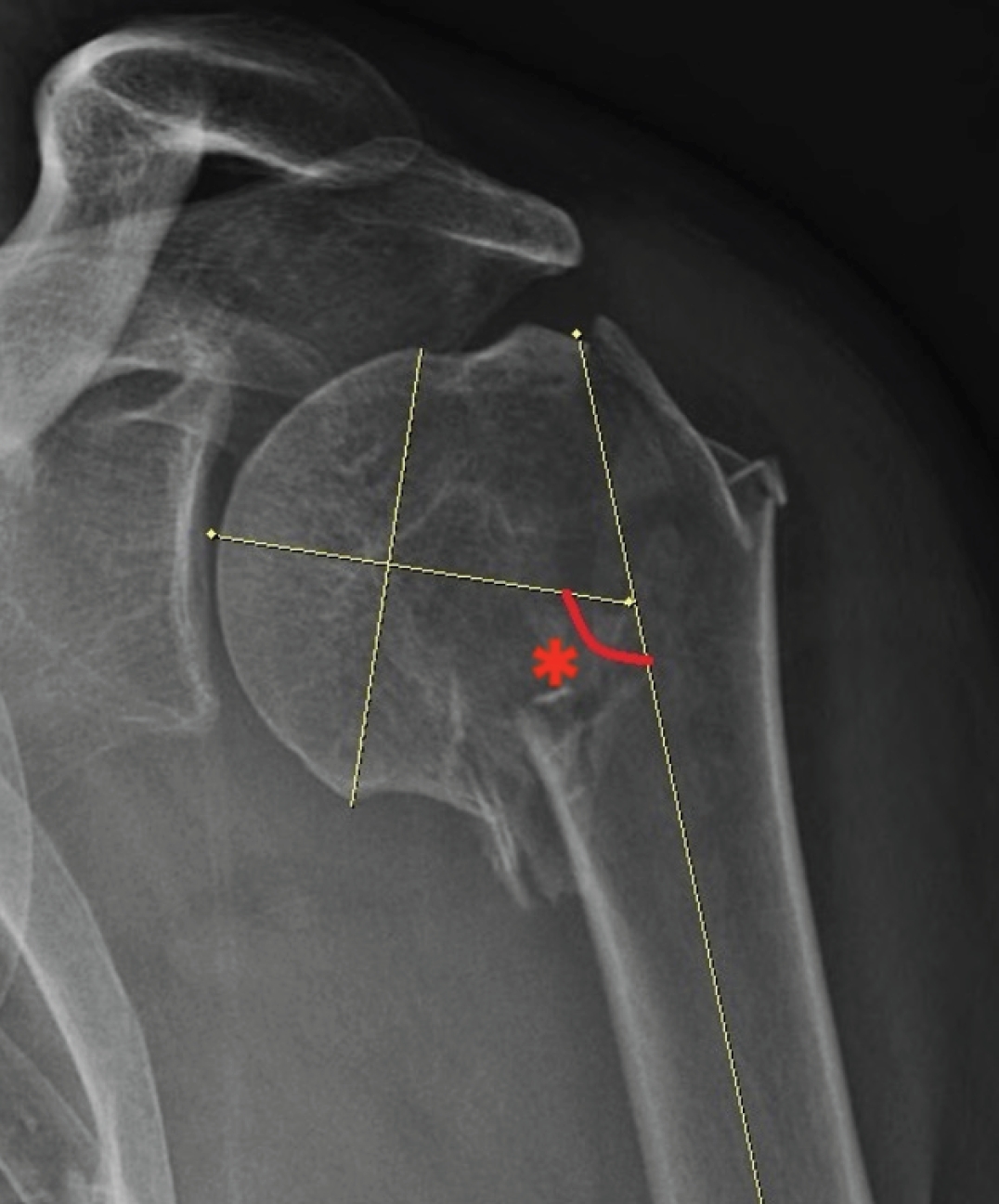
Measurement of the neck-shaft angle on an anteroposterior shoulder radiograph using the method described by Agel et al. [17]. The asterisk denotes the measured angle.
Fig. 2.
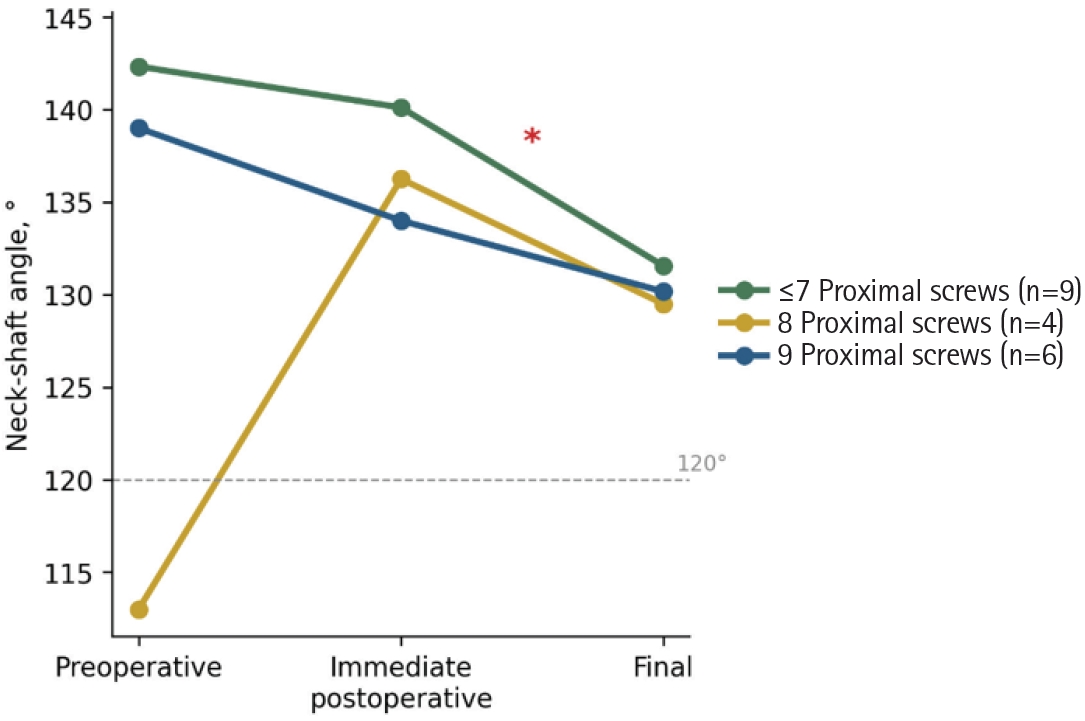
Mean neck-shaft angle at the preoperative, immediate postoperative, and final assessments, stratified by the number of proximal screws. The final assessment was performed at radiographic union. The asterisk indicates a statistically significant within-group change from the immediate postoperative to the final assessment. *P<0.05.
Fig. 3.
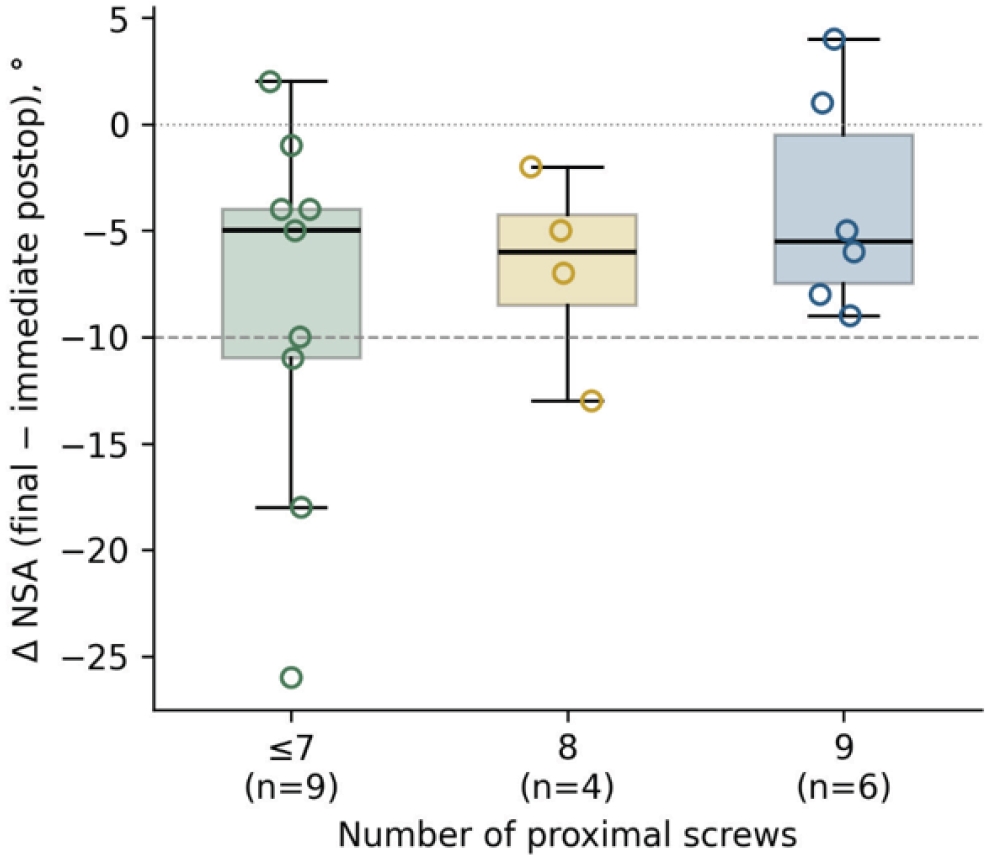
Change in neck-shaft angle (NSA) from the immediate postoperative assessment to the final assessment, stratified by the number of proximal screws. ΔNSA was calculated as final NSA minus immediate postoperative NSA.
Fig. 4.
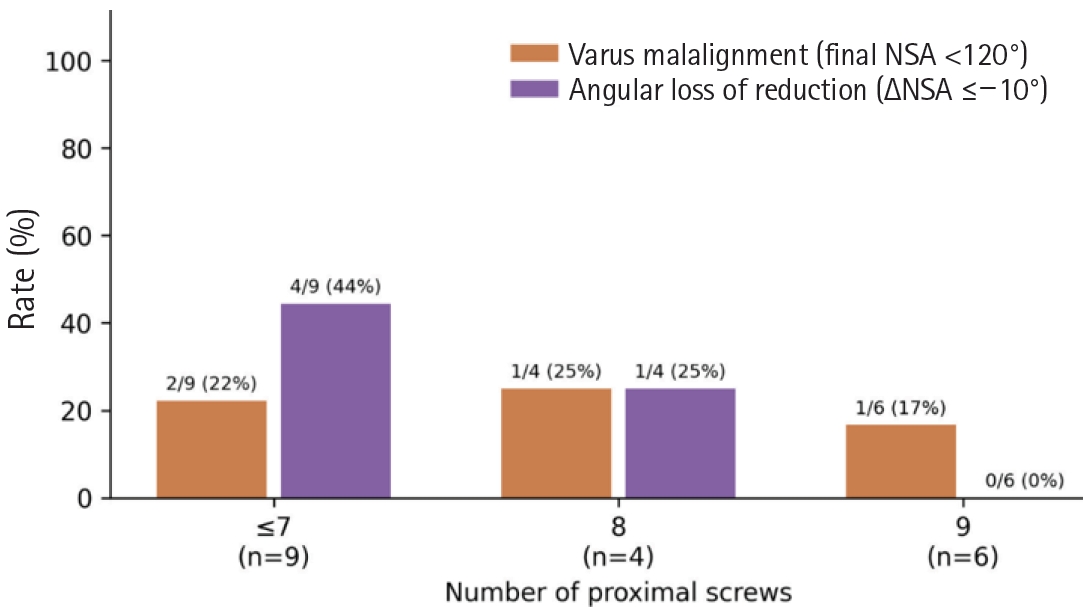
Proportions of patients with varus malalignment and angular loss of reduction, stratified by the number of proximal screws. Varus malalignment was defined as a final neck-shaft angle <120°, and angular loss of reduction was defined as ΔNSA ≤−10°. NSA, neck-shaft angle.
Table 1.
Patient demographics and fracture characteristics according to the number of proximal screws
| Variable | ≤7 (n=9) | 8 (n=4) | 9 (n=6) | P-value |
|---|---|---|---|---|
| Demographic characteristics | ||||
| Age (yr) | 65.2±14.1 | 66.2±25.0 | 75.8±18.1 | 0.267 |
| Female sex | 5 (55.6) | 1 (25.0) | 4 (66.7) | 0.421 |
| Hypertension | 6 (66.7) | 2 (50.0) | 5 (83.3) | 0.533 |
| Diabetes | 1 (11.1) | 0 (0) | 1 (16.7) | 0.700 |
| Previous fracture | 1 (11.1) | 2 (50.0) | 3 (50.0) | 0.191 |
| Smoking | 2 (22.2) | 2 (50.0) | 0 (0) | 0.163 |
| Alcohol use | 5 (55.6) | 1 (25.0) | 0 (0) | 0.073 |
| Albumin (g/dL) | 4.1±0.6 | 3.8±0.8 | 4.0±0.4 | 0.429 |
| Creatinine (mg/dL) | 1.6±2.5 | 0.8±0.2 | 0.8±0.3 | 0.517 |
| Fracture characteristics | ||||
| Preoperative varus angulationa) | 4 (44.4) | 4 (100) | 2 (33.3) | 0.121 |
| Preoperative neck-shaft angle (°) | 142.3±28.6 | 113.0±20.3 | 139.0±23.4 | 0.261 |
| Two-part fracture | 8 (88.9) | 2 (50.0) | 5 (83.3) | 0.270 |
| Medial metaphyseal comminution | 1 (11.1) | 4 (100) | 2 (33.3) | 0.008 |
| Surgical characteristics | ||||
| Plate (ARIX:PHILOS) | 4:5 | 3:1 | 6:0 | 0.106 |
| Calcar screw number | 1.2±0.7 | 1.3±0.5 | 2.0±0.0 | 0.028 |
- 1. Launonen AP, Lepola V, Saranko A, Flinkkilä T, Laitinen M, Mattila VM. Epidemiology of proximal humerus fractures. Arch Osteoporos 2015;10:209.ArticlePubMedPDF
- 2. Baron JA, Barrett JA, Karagas MR. The epidemiology of peripheral fractures. Bone 1996;18:209S-213S.ArticlePubMed
- 3. LaMartina J, Christmas KN, Simon P, et al. Difficulty in decision making in the treatment of displaced proximal humerus fractures: the effect of uncertainty on surgical outcomes. J Shoulder Elbow Surg 2018;27:470-7.ArticlePubMed
- 4. Orman S, Mohamadi A, Serino J, et al. Comparison of surgical and non-surgical treatments for 3- and 4-part proximal humerus fractures: a network meta-analysis. Shoulder Elbow 2020;12:99-108.ArticlePubMedPDF
- 5. Samborski SA, Haws BE, Karnyski S, et al. Early outcomes of proximal humerus fractures in adults treated with locked plate fixation compared with nonoperative treatment: an age-, comorbidity-, and fracture morphology-matched analysis. J Orthop Trauma 2023;37:142-8.ArticlePubMed
- 6. Fraser AN, Wagle TM, Karlberg AC, et al. Reverse shoulder arthroplasty is superior to plate fixation for displaced proximal humeral fractures in the elderly: five-year follow-up of the DelPhi randomized controlled trial. J Bone Joint Surg Am 2024;106:1945-56.ArticlePubMed
- 7. Dilisio MF, Nowinski RJ, Hatzidakis AM, Fehringer EV. Intramedullary nailing of the proximal humerus: evolution, technique, and results. J Shoulder Elbow Surg 2016;25:e130-8.ArticlePubMed
- 8. Erasmo R, Guerra G, Guerra L. Fractures and fracture-dislocations of the proximal humerus: a retrospective analysis of 82 cases treated with the Philos(®) locking plate. Injury 2014;45 Suppl 6:S43-8.ArticlePubMed
- 9. Shin WC, Kang SW, Son SM, Seo JS, Choi MH. High bone union rate using a locking plate for proximal humeral fractures in patients older than 70 years: importance of the medial column. Eur J Trauma Emerg Surg 2022;48:2937-42.ArticlePubMedPDF
- 10. Pawaskar AC, Lee KW, Kim JM, et al. Locking plate for proximal humeral fracture in the elderly population: serial change of neck shaft angle. Clin Orthop Surg 2012;4:209-15.ArticlePubMedPMC
- 11. Lim JH, Hwang J, Kim S, Kim MS. Clinical and radiographic results of locking plate with medial support screw in proximal humerus fracture: the more, the better. BMC Musculoskelet Disord 2024;25:580.ArticlePubMedPMCPDF
- 12. Yang Y, Chen Z, Hu Y, et al. Preventing reduction loss following proximal humerus fractures after locking compression plate fixation: a new clinical prediction model. BMC Musculoskelet Disord 2025;26:714.ArticlePubMedPMCPDF
- 13. Jung SW, Shim SB, Kim HM, Lee JH, Lim HS. Factors that influence reduction loss in proximal humerus fracture surgery. J Orthop Trauma 2015;29:276-82.ArticlePubMed
- 14. Kim H, Shin MJ, Kholinne E, et al. How many proximal screws are needed for a stable proximal humerus fracture fixation. Geriatr Orthop Surg Rehabil 2021;12:2151459321992744.ArticlePubMedPMCPDF
- 15. Maddah M, Prall WC, Geyer L, Wirth S, Mutschler W, Ockert B. Is loss of fixation following locked plating of proximal humeral fractures related to the number of screws and their positions in the humeral head. Orthop Rev (Pavia) 2014;6:5336.ArticlePubMedPMC
- 16. Neer CS. Displaced proximal humeral fractures. I. Classification and evaluation. J Bone Joint Surg Am 1970;52:1077-89.PubMed
- 17. Agel J, Jones CB, Sanzone AG, Camuso M, Henley MB. Treatment of proximal humeral fractures with Polarus nail fixation. J Shoulder Elbow Surg 2004;13:191-5.ArticlePubMed
- 18. Koo TK, Li MY. A guideline of selecting and reporting intraclass correlation coefficients for reliability research. J Chiropr Med 2016;15:155-63.ArticlePubMedPMC
- 19. Fleischhacker E, Siebenbürger G, Helfen T, Gleich J, Böcker W, Ockert B. Varus malposition relates to functional outcomes following open reduction and internal fixation for proximal humeral fractures: a retrospective comparative cohort study with minimum 2 years follow-up. Injury 2021;52:506-10.ArticlePubMed
- 20. Dheenadhayalan J, Prasad VD, Devendra A, Rajasekaran S. Correlation of radiological parameters to functional outcome in complex proximal humerus fracture fixation: a study of 127 cases. J Orthop Surg (Hong Kong) 2019;27:2309499019848166.ArticlePubMedPDF
- 21. Kantharaju H, Gawhale SK, Prasanna Kumar GS, Sahare B, Shah N. Factors influencing the varus deformity of humeral head in proximal humerus fractures and its relation to functional outcome. Indian J Orthop 2021;55:702-7.ArticlePubMedPMCPDF
- 22. Wang JQ, Jiang BJ, Guo WJ, Zhao YM. Serial changes in the head-shaft angle of proximal humeral fractures treated by placing locking plates: a retrospective study. BMC Musculoskelet Disord 2018;19:420.ArticlePubMedPMCPDF
References
Figure & Data
REFERENCES
Citations
Citations to this article as recorded by 
 ePub Link
 Cite
 XML Download
- Figure
-
- We recommend
- Related articles
-
- Postoperative sagittal alignment and reoperation predict late outcomes after plate fixation of AO/OTA 33C distal femur fractures: a retrospective cohort study
- Open reduction and internal fixation for distal humerus fractures in older adults: a retrospective comparative study by osteoporosis status
- Clinical and radiographic outcomes of hemiarthroplasty for proximal humeral fractures in Korea with three or more years of follow-up: a retrospective cohort study
- Hook plate versus periarticular-type volar locking plate for distal radius fractures involving the volar lunate facet in Korea: a retrospective cohort study
- Correlation of bone mineral density with ankle fractures in older adults in Korea: a retrospective cohort study
Proximal screw number and neck-shaft angle after locking plate fixation of proximal humerus fractures at a single center in Korea: a retrospective cohort study
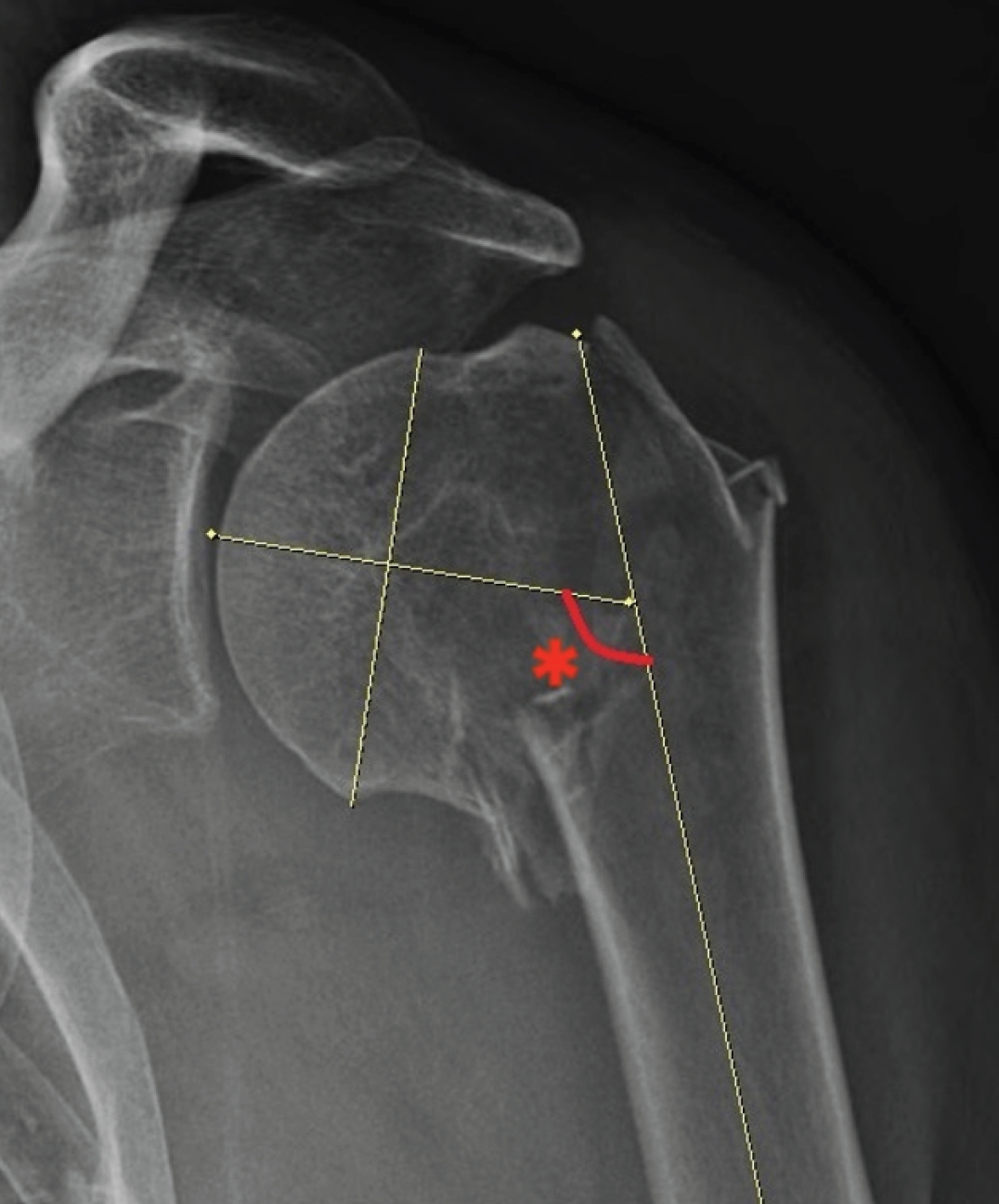
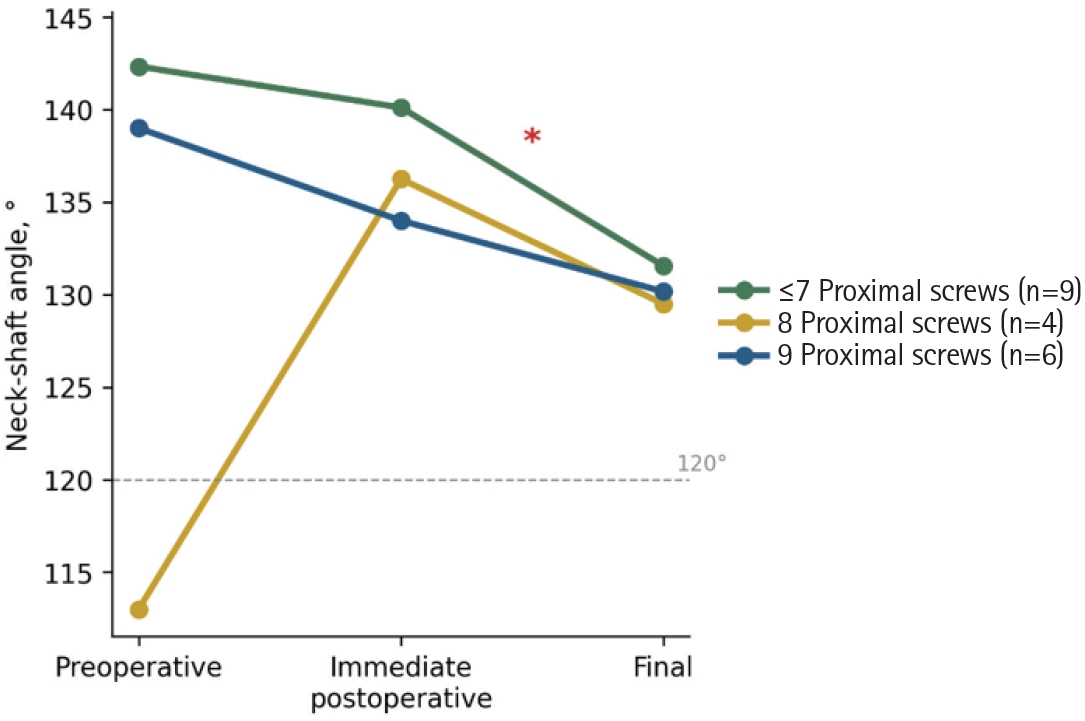
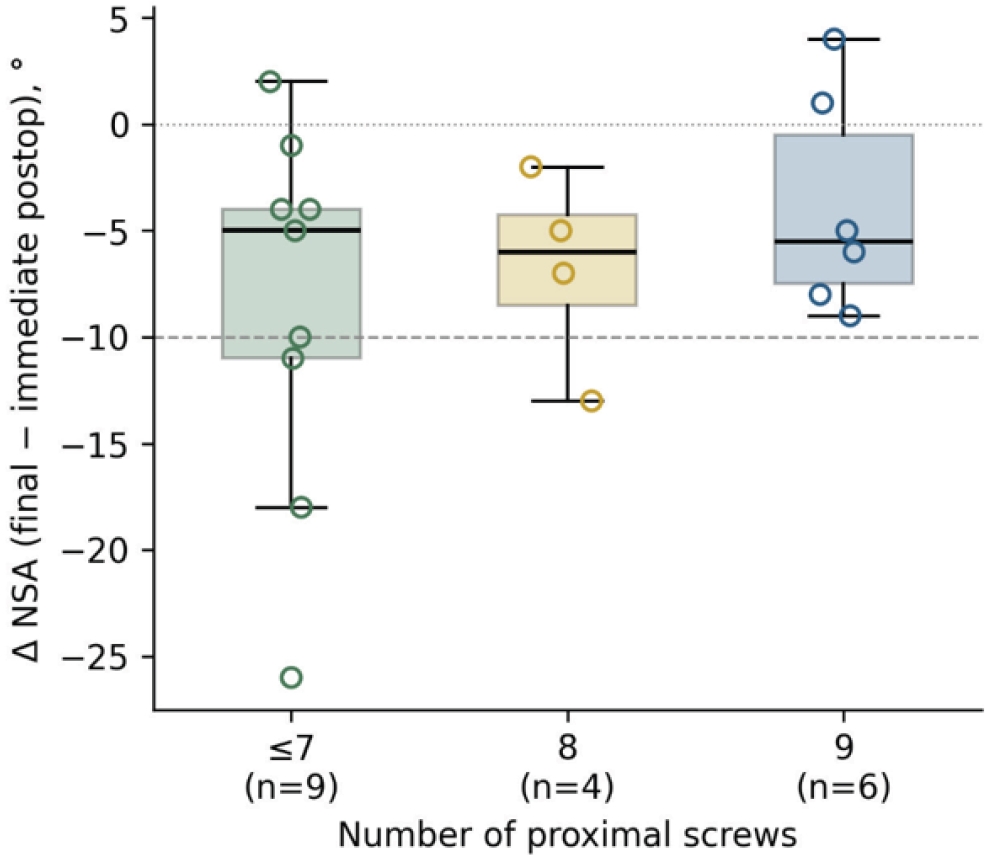
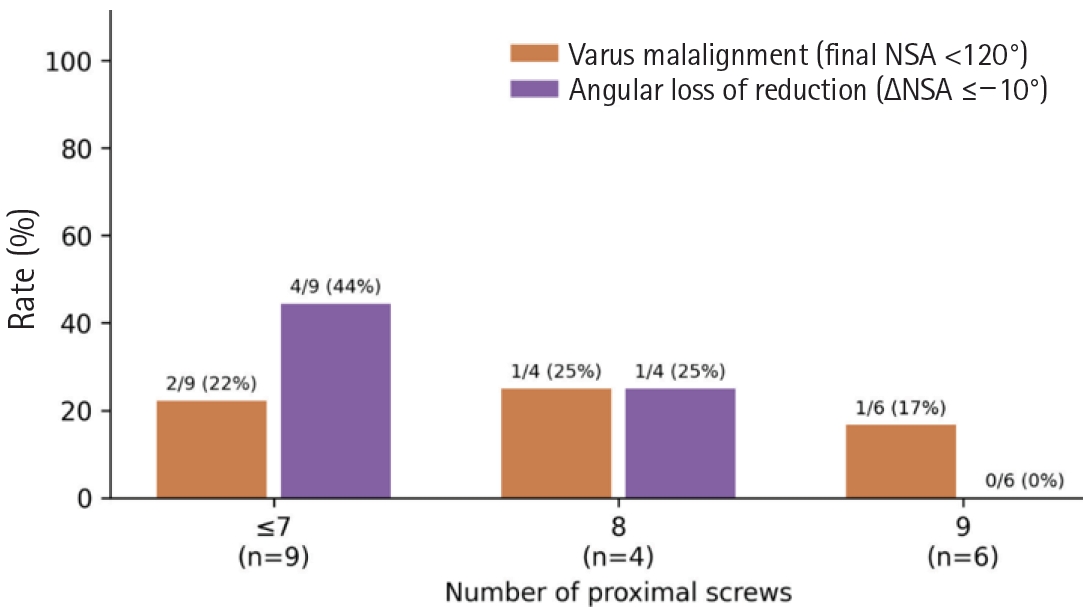
Fig. 1. Measurement of the neck-shaft angle on an anteroposterior shoulder radiograph using the method described by Agel et al. [17]. The asterisk denotes the measured angle.
Fig. 2. Mean neck-shaft angle at the preoperative, immediate postoperative, and final assessments, stratified by the number of proximal screws. The final assessment was performed at radiographic union. The asterisk indicates a statistically significant within-group change from the immediate postoperative to the final assessment. *P<0.05.
Fig. 3. Change in neck-shaft angle (NSA) from the immediate postoperative assessment to the final assessment, stratified by the number of proximal screws. ΔNSA was calculated as final NSA minus immediate postoperative NSA.
Fig. 4. Proportions of patients with varus malalignment and angular loss of reduction, stratified by the number of proximal screws. Varus malalignment was defined as a final neck-shaft angle <120°, and angular loss of reduction was defined as ΔNSA ≤−10°. NSA, neck-shaft angle.
Fig. 1.
Fig. 2.
Fig. 3.
Fig. 4.
Proximal screw number and neck-shaft angle after locking plate fixation of proximal humerus fractures at a single center in Korea: a retrospective cohort study
| Variable | ≤7 (n=9) | 8 (n=4) | 9 (n=6) | P-value |
|---|---|---|---|---|
| Demographic characteristics | ||||
| Age (yr) | 65.2±14.1 | 66.2±25.0 | 75.8±18.1 | 0.267 |
| Female sex | 5 (55.6) | 1 (25.0) | 4 (66.7) | 0.421 |
| Hypertension | 6 (66.7) | 2 (50.0) | 5 (83.3) | 0.533 |
| Diabetes | 1 (11.1) | 0 (0) | 1 (16.7) | 0.700 |
| Previous fracture | 1 (11.1) | 2 (50.0) | 3 (50.0) | 0.191 |
| Smoking | 2 (22.2) | 2 (50.0) | 0 (0) | 0.163 |
| Alcohol use | 5 (55.6) | 1 (25.0) | 0 (0) | 0.073 |
| Albumin (g/dL) | 4.1±0.6 | 3.8±0.8 | 4.0±0.4 | 0.429 |
| Creatinine (mg/dL) | 1.6±2.5 | 0.8±0.2 | 0.8±0.3 | 0.517 |
| Fracture characteristics | ||||
| Preoperative varus angulation |
4 (44.4) | 4 (100) | 2 (33.3) | 0.121 |
| Preoperative neck-shaft angle (°) | 142.3±28.6 | 113.0±20.3 | 139.0±23.4 | 0.261 |
| Two-part fracture | 8 (88.9) | 2 (50.0) | 5 (83.3) | 0.270 |
| Medial metaphyseal comminution | 1 (11.1) | 4 (100) | 2 (33.3) | 0.008 |
| Surgical characteristics | ||||
| Plate (ARIX:PHILOS) | 4:5 | 3:1 | 6:0 | 0.106 |
| Calcar screw number | 1.2±0.7 | 1.3±0.5 | 2.0±0.0 | 0.028 |
Table 1. Patient demographics and fracture characteristics according to the number of proximal screws
Values are presented as mean±standard deviation or number (%). Preoperative neck-shaft angle <135°.


