
 E-submission
 KOTA
KOTA TOTA
TOTA TOTS
TOTS
Search
- Page Path
- HOME > Search
Technical Note
- Rim plate-assisted intramedullary nail and plate combination technique for complex tibial plateau-to-diaphysis fractures: a technical note and case series
- Whee Sung Son
- J Musculoskelet Trauma 2026;39(1):62-71. Published online December 4, 2025
- DOI: https://doi.org/10.12671/jmt.2025.00290
-
 Abstract
 PDF
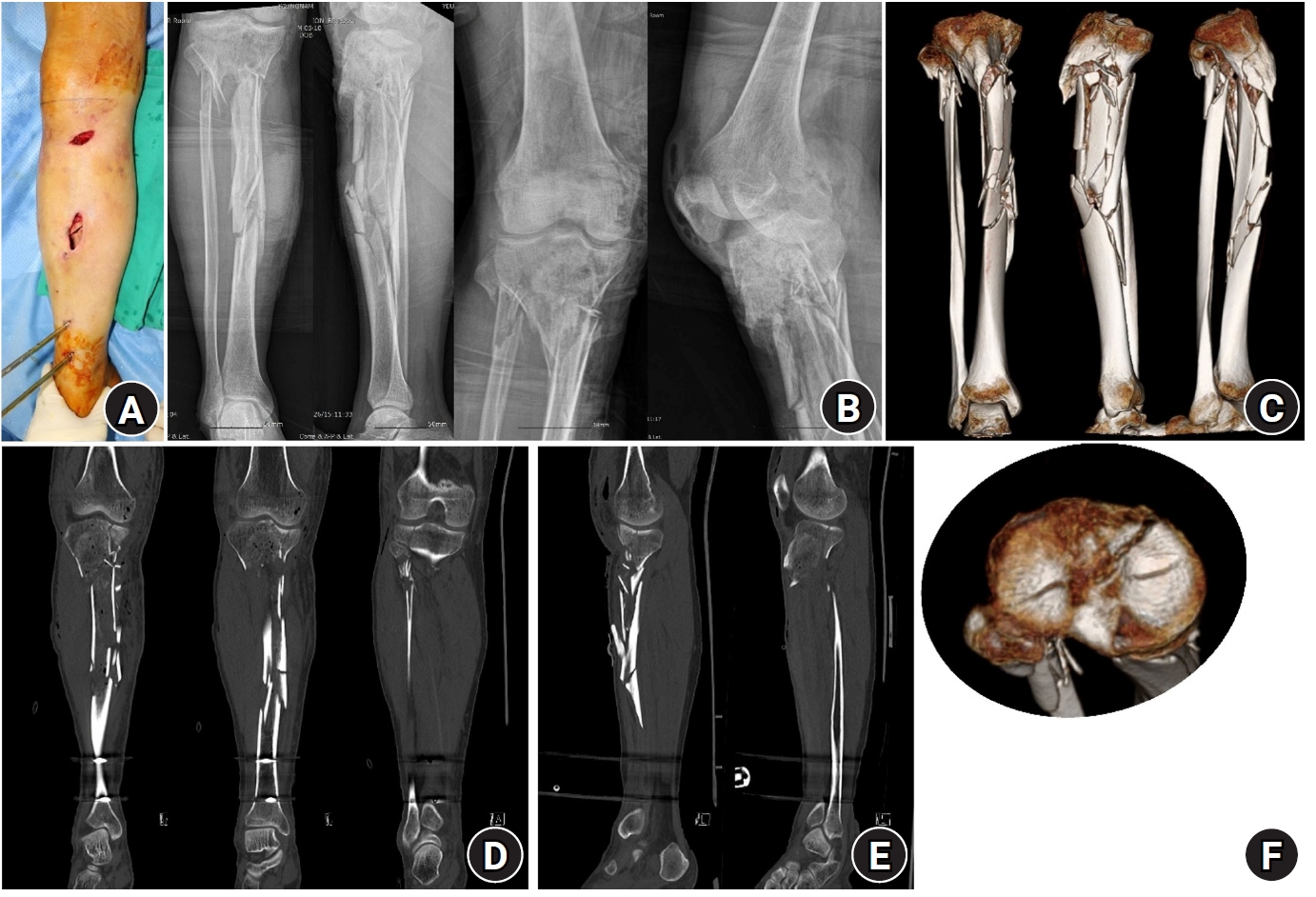
PDF - Complex tibial plateau-to-diaphysis fractures present a significant surgical challenge due to their intricate fracture patterns and frequent association with severe soft tissue damage and concomitant injuries. This technical note introduces a novel fixation strategy: the rim plate-assisted intramedullary nail-plate combination (NPC) technique. In this approach, a rim plate simplifies the conventional NPC procedure by unifying the tibial plateau fracture into a single structural segment. This modification eliminates the need to address the articular and diaphyseal components simultaneously while enhancing articular stability. Furthermore, the technique preserves soft tissue integrity and promotes early rehabilitation. Clinical case examples demonstrate its successful application in managing complex tibial plateau-to-diaphysis injuries. Level of evidence: V.
- 2,057 View
- 79 Download

Original Article
- Evaluation of the Patterns of Fractures and the Soft Tissue Injury Using MRI in Tibial Plateau Fractures
- Ji Yong Chun, Hee Gon Park, Sung Su Hwang
- J Korean Fract Soc 2007;20(4):302-308. Published online October 31, 2007
- DOI: https://doi.org/10.12671/jkfs.2007.20.4.302
-
Abstract
PDF
- PURPOSE
To compare information about fracture type in MRI with simple radiograph in tibial plateau fractures and evaluate tibial plateau fractures type and accompanying soft tissue injury, and evaluate usefulness of MRI in tibial plateau fractures.
MATERIALS AND METHODS
Compared MRI with simple radiograph about Schatzker classification, depression of articular surface and displacement of bone fragment from the 68 examples who checked MRI and we evaluated soft tissue injury around knee joint.
RESULTS
There were 7 examples of Schatzker type change after MRI check. Average depression of articular surface in simple radiograph was 2.93 mm and 4.28 mm in MRI. It increased by 1.35 mm and it was meaningful statistically (p<0.05). There was no significant difference between MRI and simple radiograph of displaced bone fragment (p=0.168). There were 58 (85.3%) cases of soft tissue injury in MRI.
CONCLUSION
MRI can find additional fracture line or articular depression that can't be found in simple radiograph and gives more information about articular depression and soft tissue that is useful in surgical plans. I think preoperative MRI is necessary to better treatment of fracture & treatment of periarticular soft tissue injury in tibial plateau fracture. -
Citations
Citations to this article as recorded by
- The Use of Fresh Frozen Allogenic Bone Graft in the Impacted Tibial Plateau Fractures
Yeung Jin Kim, Soo Uk Chae, Jung Hwan Yang, Ji Wan Lee, Dae Han Wi, Duk Hwa Choi
Journal of the Korean Fracture Society.2010; 23(1): 26. CrossRef
- The Use of Fresh Frozen Allogenic Bone Graft in the Impacted Tibial Plateau Fractures
- 1,947 View
- 7 Download
- 1 Crossref
 First
First Prev
Prev


