
 E-submission
 KOTA
 TOTA
 TOTS

Search
- Page Path
- HOME > Search
Original Article
- Correlation of bone mineral density with ankle fractures in older adults in Korea: a retrospective cohort study
- Seung Hyun Lee, Chae Hun Lee, Seo Jin Park, Jun Young Lee
- J Musculoskelet Trauma 2025;38(4):186-192. Published online October 24, 2025
- DOI: https://doi.org/10.12671/jmt.2025.00150
-
 Abstract
 PDF
- Background
Bone mineral density (BMD) is well-documented in relation to fractures of the spine, hip, distal radius, and proximal humerus; however, its correlations with other fracture types are less established. This study aimed to analyze BMD and associated risk factors in older adults (≥65 years of age) with osteoporotic ankle fractures. These fractures involve low-energy trauma, resulting from falls from a standing height or lower, and occur from impacts which typically do not cause fractures in individuals with normal bone.
Methods
This retrospective study analyzed data from 1,411 patients diagnosed with ankle fractures admitted to Chosun University Hospital between February 2012 and April 2023. After applying inclusion criteria (age ≥65 years; low-energy ankle fracture) and exclusion criteria (high-energy trauma, open/multiple fractures, missing dual-energy X-ray absorptiometry [DXA]), 73 of 1,411 patients were analyzed. Lumbar spine, femoral neck, and total hip T-scores were obtained with a Horizon Wi DXA scanner, and associations with age, sex, mechanism of injury, comorbidities, smoking status, alcohol consumption, body mass index (BMI), and history of fractures were tested by independent t-tests and one-way ANOVA with Scheffé post hoc tests.
Results
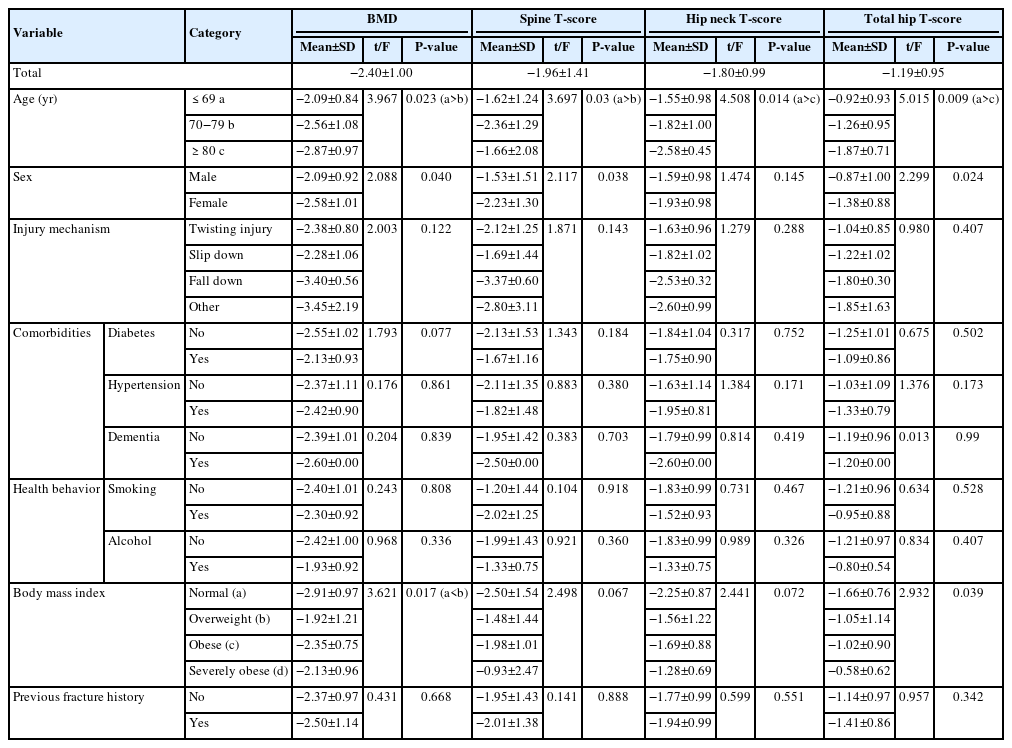
Significant differences in BMD were observed according to age, sex, and BMI. Age was significantly associated with the lowest, femoral neck, and total hip T-scores, sex with the lowest T-score, lumbar spine, and total hip T-scores, and BMI with the lowest and total hip T-scores (P<0.05). No significant associations were found with diabetes, hypertension, smoking, alcohol consumption, injury mechanism, or prior fractures; dementia was not tested because only one patient had dementia.
Conclusions
These results suggest that age, sex, and BMI are associated with BMD in older patients with ankle fractures, although the associations varied according to the measured site. These findings support the importance of osteoporosis screening and management in this population, particularly in women. Level of evidence: IV. -
Citations
Citations to this article as recorded by
- Pectoralis major reference technique improves humeral height restoration and tuberosity healing after hemiarthroplasty for complex proximal humeral fractures: A comparative study
Bum-Soon Park, Du-Han Kim, Hyuk-Joon Sohn, Chul-Hyun Cho
Injury.2026; 57(10): 113651. CrossRef
- Pectoralis major reference technique improves humeral height restoration and tuberosity healing after hemiarthroplasty for complex proximal humeral fractures: A comparative study
- 2,204 View
- 53 Download
- 1 Crossref

 First
 Prev



