
 E-submission
 KOTA
KOTA TOTA
TOTA TOTS
TOTS
Search
- Page Path
- HOME > Search
Review Article
- Current concepts and applications of bone graft substitutes in orthopedic surgery
- Jae Ho Cho, Hyung Keun Song
- J Musculoskelet Trauma 2025;38(4):169-177. Published online October 24, 2025
- DOI: https://doi.org/10.12671/jmt.2025.00248
-
 Abstract
 PDF
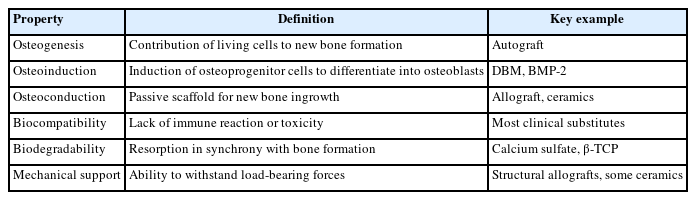
PDF - Bone defects, which often arise from high-energy injuries, infections, tumor resections, or nonunions, represent a persistent challenge in orthopedic trauma surgery. Autologous bone grafting remains the gold standard due to its unique combination of osteogenic, osteoinductive, and osteoconductive properties. However, issues such as donor site morbidity, limited graft volume, and increased surgical time have driven the development of bone graft substitutes. These substitutes vary widely in origin, composition, biological activity, and mechanical characteristics, encompassing allografts, xenografts, synthetic materials, and biologically enhanced constructs. This review outlines the fundamental biological principles underlying bone regeneration—including osteogenesis, osteoinduction, and osteoconduction—and addresses additional key factors such as biocompatibility, biodegradability, and mechanical strength. Current bone graft materials are classified by biological origin and functional characteristics, with an emphasis on their use in trauma surgery. Particular attention is given to the clinical applications, indications, and limitations of allograft-based solutions (such as structural allografts and demineralized bone matrix), synthetic ceramics (including calcium phosphate and bioactive glass), and biologically enhanced options, such as recombinant growth factors and stem cell therapies. In trauma settings, graft selection must be tailored to the characteristics of the defect, mechanical demands, the biological environment, and patient-specific factors. Integration with surgical technique and fixation is crucial for optimizing outcomes. Although modern substitutes show promise, none fully replicate the complex biology of autografts. Looking ahead, emerging technologies such as 3D printing, nanotechnology, and smart biomaterials offer exciting possibilities but face translational challenges. This review aims to provide practicing orthopedic surgeons with a concise, evidence-based overview of bone substitute options and their roles in trauma care. By applying core biological principles and clinical judgment, surgeons can better navigate the expanding array of graft materials to improve outcomes for patients with complex skeletal defects.
-
Citations
Citations to this article as recorded by
- Safety and Efficacy of rhBMP-2 for Treating Acute Traumatic Fractures of the Upper and Lower Extremities: A Multicenter Prospective Study
Seungyeob Sakong, Seokjun Hong, Wonseok Choi, Seonghyun Kang, Jae-Woo Cho, Whee Sung Son, Jeong-Seok Choi, Chang-Jin Yon, Won-Tae Cho, Jong-Keon Oh
Journal of Clinical Medicine.2026; 15(3): 1176. CrossRef - Plasma‐Assisted KR‐12 Conjugated PLGA Nanofibers With Dual Osteogenic and Biofilm‐Inhibitory Activity
Günnur Pulat, Eda Bilgiç, Buse Sezer
Journal of Biomedical Materials Research Part A.2026;[Epub] CrossRef - Histological Study of a Novel 3D-Printed Hydroxyapatite/PLGA Bone Graft in the Regeneration of Critical-Sized Long Bone Defects
Marijana Popović Bajić, Smiljana Paraš, Milutin Mićić, Božana Petrović, Vladimir Biočanin, Slavoljub Živković, Marija Živković, Damjana Drobne, Vukoman Jokanović
Bioengineering.2026; 13(4): 394. CrossRef - The Use of Osteo-Inductive 3D-Printed Scaffolds Covered with a Pleiotrophin Peptide for Bone Defects: An In Vivo Experimental Study
Dimitrios Tsoumanis, Emilios E. Pakos, Ioannis Gkiatas, Ioannis Gelalis, Anna Batistatou, Evangelia Lampri, Despoina Deligianni, Evangelia Papadimitriou, Dimitrios Fotiadis, Anastasios Korompilias
Bioengineering.2026; 13(6): 608. CrossRef - Research advances in bioactive bone graft materials and bone marrow enrichment techniques for bone defect treatment
Zhezheng Shen, Xueyuan Li, Zijun Ye, Yuhao Zhou, Di Tu, Zongying Tian, Wei Qian
Cell Transplantation.2026;[Epub] CrossRef - A Novel Technique of Overlapping Distal Stump Within Femoral Allograft-Prosthesis Composite for Extensive Humeral Bone Loss in Revision Total Elbow Arthroplasty
Chul-Hyun Cho, Bum-Soon Park, Eun-Seok Son, Du-Han Kim
Techniques in Orthopaedics.2026;[Epub] CrossRef - Enhancing Bone Healing with a Priming Stimulus
Michael Tanzer, Misghana Kassa, Nitin Chandra Teja Dadi, Tarek Klaylat, Rahul Gawri, Paul Martineau, Adam Hart
Life.2026; 16(7): 1111. CrossRef - From powder to patient: A critical overview of 3D-printed bioceramics for bone tissue engineering
Yeajin Song, Shinwon Kang, Seonkyeong Lee, Inseon Kim, Seunghun S. Lee
Ceramics International.2026;[Epub] CrossRef - Comparative Analysis of Bone Remodeling Dynamics and Bone Vitality Following Standard Bone Augmentation Procedures: A Review
Nikola Gapińska, Marek Śmielecki, Kornel Krasny
Journal of Functional Biomaterials.2026; 17(8): 398. CrossRef - Editorial Commentary: Graft Source May Not Be the Main Determinant to Union When Treating Unstable Scaphoid Fracture Nonunions
Benjamin R. Graves
Arthroscopy.2026; 42(10): 2047. CrossRef - Development of a pH-responsive nanofibrous scaffold for therapeutic applications in bone tissue engineering: A comparative evaluation of three-layered vs single-layered fibers
Sthuthi Jose. M, Sumathi Shanmugam
Chemical Physics Impact.2026; 13: 101160. CrossRef - Surgical strategies for atypical femoral fracture nonunion: Augmentative plating with or without exchange nailing
Do Hun Kim, Chul-Ho Kim, Ji Wan Kim
Journal of Orthopaedic Science.2026;[Epub] CrossRef - Порівняльна оцінка ефективності остеопластичних матеріалів різної біологічної активності при репаративній регенерації експериментального дірчастого дефекту стегнової кістки
Павло Бідзіля, Юлія Ковальова, Михайло Процайло, Іван Кліщ
Шпитальна хірургія. Журнал імені Л. Я. Ковальчука.2026; (3): 138. CrossRef - Vancomycin elution from gamma-irradiated cancellous bone allograft: an in vitro study linking soaking concentration to clinically relevant antimicrobial thresholds
Azura Mansor, Kah Sui Tan, Cindy Shuan Ju Teh, Zhi Xian Kong, Hai Yen Lee
Cell and Tissue Banking.2026;[Epub] CrossRef
- Safety and Efficacy of rhBMP-2 for Treating Acute Traumatic Fractures of the Upper and Lower Extremities: A Multicenter Prospective Study
- 14,146 View
- 359 Download
- 14 Crossref

 First
First Prev
Prev


